
2026 Astronomy Calendar: Meteor Showers, Lunar Eclipses, and Planets Visible from Japan
The 2026 night sky makes the most sense when you anchor it around the total lunar eclipse on March 3. This guide covers eclipse timing for observers in Japan (all times in JST, UTC+9), meteor shower peak times with moon conditions, and the best directions for planet-watching, all organized month by month so you can decide what to look for in about three minutes.
What matters most is that among the major phenomena visible nationwide in Japan in 2026, the total lunar eclipse stands as the top priority. I also cover the favorable Mercury window in mid-to-late February and the much-discussed six-planet lineup around February 28. Everything here is filtered for what you can actually see with the naked eye, which part of the sky to face, and how to avoid confusion at the observing site.
2026 Astronomy Calendar at a Glance: Key Events Worth Marking
Month-by-Month Overview
The fastest way to get oriented is a month-by-month table of events worth stepping outside for. This table uses Japan Standard Time (JST, UTC+9) and focuses on what a beginner can realistically put on the calendar. For eclipses and occultations that depend on location, visibility notes are included. While 2026 has two lunar eclipses and two solar eclipses, only the March 3 total lunar eclipse is visible from Japan. Eclipses not visible from Japan are marked Not visible from Japan.
| Month | Date/Period (JST) | Event Type | Highlights | Visible from Japan? | Visibility | Difficulty |
|---|---|---|---|---|---|---|
| Jan | 1/4 ~6:00 peak (best around 5:00 in Japan) | Meteor shower | Quadrantids. Moon age 15; strong moonlight makes conditions unfavorable | Yes | Nationwide | Level 3 |
| Jan | 1/7 | Occultation | Regulus occultation | Partial | Parts of Kyushu (excluding Okinawa) | Level 4 |
| Feb | Mid to late Feb | Planet viewing | Mercury at a favorable elongation. Sites with a clear low horizon have the advantage | Yes | Nationwide | Level 2 |
| Feb | ~2/28, 30-60 min after sunset | Planetary lineup | Six planets potentially visible in the same evening sky. Actual visibility depends heavily on your low-horizon clearance, twilight, and weather. Uranus and Neptune require binoculars or a telescope. | Possible | Site-dependent | Level 4 |
| Mar | 3/2 | Occultation | Regulus occultation. Visible over a wider area than in January | Yes | Wide coverage | Level 3 |
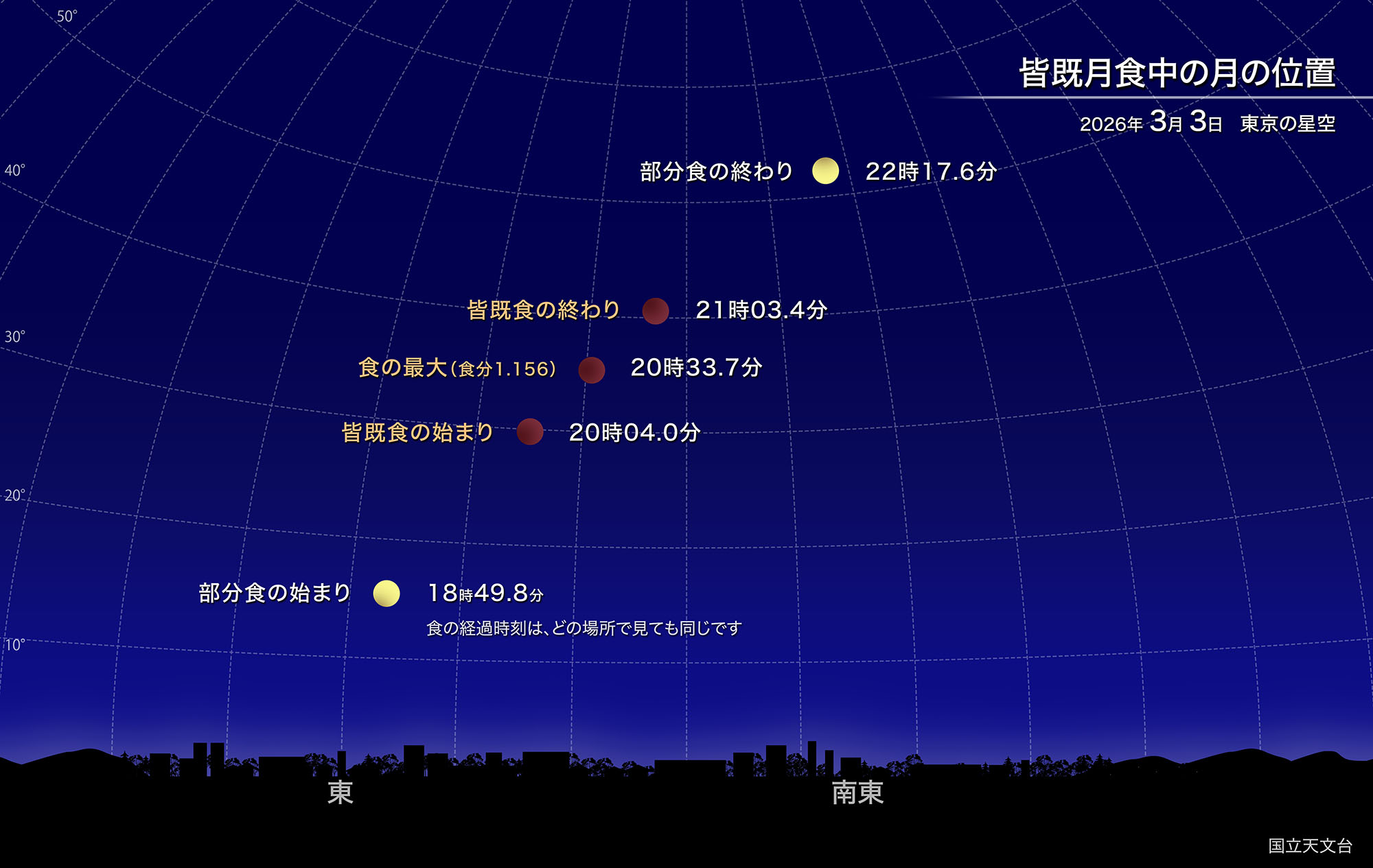
| Mar | 3/3, ~18:50-22:18 | Lunar eclipse | Total lunar eclipse. Totality begins 20:04, ends 21:03 | Yes | Nationwide | Level 1 |
| Apr | ~4/18 pre-dawn | Planetary lineup | Multiple planets line up in the pre-dawn low sky. Visibility depends on low-horizon clearance and twilight progression. Some objects require equipment. | Possible | Site-dependent | Level 4 |
| Apr | 4/23 ~4:30 peak | Meteor shower | Lyrids. Moon age 5; moon sets around midnight, relatively good conditions | Yes | Nationwide | Level 2 |
| May | ~5/6 | Meteor shower | Eta Aquariids. A pre-dawn shower | Yes | Nationwide | Level 3 |
| Aug | Mid-Aug | Meteor shower | Perseids. 2026 is expected to offer excellent conditions | Yes | Nationwide | Level 2 |
| Aug | 8/12 morning | Planetary lineup | Candidate for a major planetary alignment at dawn. Observing requires a clear low horizon; mountains and buildings easily block the view. Uranus and Neptune are not visible to the naked eye and require equipment. | Possible | Site-dependent | Level 5 |
| Aug | 8/12 | Solar eclipse | Solar eclipse | Not visible from Japan | Not visible from Japan | Level 5 |
| Oct | Late Oct | Meteor shower | Orionids. Expected to be a good year | Yes | Nationwide | Level 2 |
| Nov | 11/14 morning | Planetary lineup | Mercury, Venus, Mars, and Jupiter in a candidate lineup. Mercury sits very low, making this site-dependent; binoculars may be needed. | Possible | Site-dependent | Level 4 |
| Dec | 12/14 ~23:00 peak | Meteor shower | Geminids. Moon age 6, moon sets around 21:00; excellent conditions | Yes | Nationwide | Level 1 |
Among these, the dates to lock in first are the March 3 total lunar eclipse, the April 23 Lyrids, the mid-August Perseids, and the December 14 Geminids. The March 3 eclipse, in particular, has exact timing published by the National Astronomical Observatory of Japan (NAOJ) in their "Total Lunar Eclipse (March 2026)" page, and the fact that everyone in Japan shares the same viewing window is a significant advantage.
The planetary lineups around February 28, April 18, the morning of August 12, and the morning of November 14 are the type of events compiled by specialist media outlets like Star Walk rather than standard annual highlights from NAOJ. From my own experience, these alignments are less about whether they are "visible" and more about how much of the low horizon you can actually see. A site where you can scan all the way down to the western or eastern horizon makes them easy to pick out; a residential area full of power lines and buildings makes them far harder.
For meteor showers, staring directly at the radiant is less effective than letting your gaze drift across a wide stretch of sky. NAOJ's observing guide for meteor showers recommends the same approach, and in the field it holds true: using your full field of view from overhead to the edges tends to yield more sightings. The January Quadrantids are well-known, but 2026's near-full-moon conditions make them tough. In terms of sheer scheduling convenience, April and December offer much better setups this year.
皆既月食(2026年3月) | 国立天文台(NAOJ)
3月3日の夜に皆既月食が起こります。この月食は日本全国で見ることができます。
www.nao.ac.jpHow to Read the Difficulty Levels
These levels are not about how rare a phenomenon is. They reflect how easy it is for a beginner to actually spot it on site. Events you can enjoy simply by looking up get the lowest numbers; events that demand a clear low horizon, precise timing, regional conditions, or identifying faint objects get higher numbers.
Level 1 covers events you can enjoy just by stepping outside. In 2026, the March 3 total lunar eclipse and the December 14 Geminids fall here. The lunar eclipse features the Moon itself as the star of the show, so binoculars are not required. The Geminids benefit from both favorable timing and moon conditions.
Level 2 includes events that are perfectly naked-eye targets but require a bit of awareness about direction and timing. The April Lyrids, August Perseids, and October Orionids belong here. Getting to a dark site makes a real difference, but the basics are straightforward.
Level 3 involves slightly tougher conditions. The January Quadrantids with their interfering moonlight, the Eta Aquariids centered around pre-dawn hours, and occultations that require understanding the timeline all land here. These are the events where "it was over faster than I expected" tends to happen.
Level 4 calls for the ability to read the sky. The late-February and mid-November planetary lineups, plus the January 7 Regulus occultation, belong in this category. Even though bright planets like Venus and Jupiter are easy to find, Mercury and Saturn tend to get swallowed by low-altitude twilight, raising the on-site difficulty a notch.
Level 5 covers eclipses not visible from Japan, events that practically require binoculars or a telescope, and alignments that include very faint targets. Eclipses invisible from Japan are placed here to de-prioritize them for planning purposes. The morning of August 12, if you want to appreciate the lineup all the way out to Uranus and Neptune, also fits this tier.
💡 Tip
A higher Level does not mean a more spectacular event. In practice, a Level 1 total lunar eclipse is often more satisfying than a Level 5 alignment candidate.
Eclipses Not Visible from Japan
A common point of confusion when building an annual calendar is why some eclipses barely appear in the table despite 2026 having four of them. Sorting by visibility from Japan clears this up. According to NAOJ's "Celestial Highlights 2026" and the official almanac, 2026 has two lunar eclipses and two solar eclipses, but the only lunar eclipse visible from Japan is the March 3 total lunar eclipse.
Rather than pretending the invisible eclipses do not exist, this overview marks them as Not visible from Japan and keeps them in the table. This makes it easier to understand that 2026 is not a year with few eclipses; it is a year where the spotlight for Japan-based observers converges on March 3.
Years when eclipses that generate excitement overseas are invisible from Japan are not uncommon. In practical observation planning, failing to make this distinction clutters the schedule. Chasing phenomena you cannot see with the same enthusiasm as those you can pulls attention away from the nights that genuinely matter. For 2026, the clearest example is March 3, and the most practical approach is to lock it in first as a nationwide observing date.

ほしぞら情報2026年 | 国立天文台(NAOJ)
2026年の注目したい天体現象や各月のほしぞら情報の一覧。
www.nao.ac.jpThree Must-See Astronomy Events in Japan for 2026
2026 is packed with opportunities, but if a beginner needs to commit dates to the calendar, these three come first. The reasoning is simple: they all satisfy three conditions at once -- easy to see from Japan, enjoyable with the naked eye, and hard to mess up. At star parties, when someone asks "what should I see in my first year to feel like it was worth it," I always start with nights like these, where just looking up produces results. It raises the satisfaction of that first outing considerably.
March 3: Total Lunar Eclipse
The headliner of 2026 is the March 3 total lunar eclipse. NAOJ's dedicated page provides exact times, and it is observable from all of Japan. Partial eclipse begins around 18:50, totality starts at 20:04, totality ends at 21:03, and partial eclipse wraps up around 22:18 (all JST). The whole thing unfolds during after-dinner hours, so there is no need to organize a special trip to see it.
This earns a Level 1 rating because the Moon itself is the subject. Unlike meteor showers, where you might wait minutes without a single streak, there is no "nothing happened" scenario here. If the Moon is above the horizon, you can follow the progression with your eyes. During totality, the Moon takes on a coppery red tone, and people who have only ever seen a regular full moon tend to find it striking. At beginner-oriented star parties I have helped run, starting with a lunar eclipse reliably draws reactions along the lines of "I had no idea you could see this much change with just your eyes."
Choosing a location is not complicated either. The Moon will be in the east to southeast sky, so anywhere with an unobstructed view in that direction works -- a neighborhood park, a wide pedestrian overpass, or similar spots are all fine (observing site examples: Lake Okutama -- /spot/okutama-lake, Achi Village Namiai Park -- /spot/achi-village). No telescope is needed. Binoculars, if you have them, make it a bit easier to follow the color differences along the shadow's edge and across the darkened surface.
When, where, and how to watch: Focus on ~18:50 to 21:03, face east to southeast, and pick a nearby spot with an open eastern horizon.
Mid-August: Perseid Meteor Shower
The summer highlight is the mid-August Perseid meteor shower. Moon conditions in 2026 are expected to be favorable, placing this among the easier meteor showers to target for the year. The timing overlaps with summer vacation, making it practical to plan a late-night session and easy to turn into an outing with family or friends.
The Perseids earn an easy Level 1 rating largely thanks to the season. Compared to winter showers, the cold-weather barrier is gone, and the psychological hurdle of being outside at night is much lower. On site, the summer advantage boils down to this: you can lie on your back and wait, and that alone makes participation more accessible. The key to observing is not to fixate on the radiant direction but to let your eyes wander across a wide area of sky. Meteors often enter at the edge of your vision, so a broad field of view catches more of them.
The prime window runs from late evening through pre-dawn. Meteor activity tends to pick up after midnight, and the darker and more open your site, the better. Riverbanks in the suburbs, highland plateaus, seaside parking areas -- places with minimal streetlights and a wide overhead view produce the best results. While 2026 is expected to be a good year, meteor shower impressions shift with the Moon's position, so checking the moon age and moonrise/moonset times right before your observing date keeps your plan solid.
When, where, and how to watch: Evening through pre-dawn, scan the entire sky rather than one fixed direction, and choose a site with minimal artificial light and a wide-open view.
December 14: Geminid Meteor Shower
The year-end headliner is the December 14 Geminid meteor shower. In 2026, the peak arrives around 23:00 JST, and with a moon age of 6 and moonset around 21:00, the conditions line up well. Better still, this shower offers chances throughout the entire night, not just around the peak.
The hype is justified -- not just because of name recognition, but because the expected counts are high and the timing is realistic. Unlike the Quadrantids with their brutal early-morning peak, you can start hunting under crisp winter skies from a reasonable evening hour. If you can get to a suburban dark site, naked-eye counts should be rewarding. The Geminids are the poster child for "first meteor shower trip that actually delivers." There is always some waiting, but once you spot one, a string of follow-ups is not unusual.
Winter demands proper layering, but the observing itself is straightforward. The radiant lies in Gemini, but you will spot more meteors by scanning the wide sky from northeast through the zenith. In residential areas you may catch a few, but getting to a darker suburban location gives the shower room to show its volume. Once you settle into a site with a clear overhead view, the upper half of your field of vision becomes a continuous observing stage, and the Geminids start to deliver that "they just keep coming" feeling.
When, where, and how to watch: 21:00 onward through late night, cover the wide sky from northeast to zenith, and head to a dark suburban site.
Comparing all three: for certainty, the March 3 total lunar eclipse; for seasonal ease, the August Perseids; for sheer meteor counts, the December 14 Geminids. If someone asked me to recommend just three nights of stargazing in 2026, this is the order I would give.
2026 Meteor Shower Calendar: Peak Times, Moon Conditions, and Best Viewing Windows
Knowing what a "radiant" means up front makes planning meteor observations far smoother. The radiant is the point in the sky from which a shower's meteors appear to fan outward, located near the constellation the shower is named after. Staring at it, though, is not the most productive strategy. Meteors streak across wide areas of sky, so using the radiant as a reference while scanning broadly catches more of them. On moonlit nights, turn your back to the Moon. Pick a spot with an open eastern sky, spread out a blanket or recline in a chair, and give your field of view as much room as possible.
Quadrantids
Predicted peak (JST): around 6:00 on January 4; the practical best window in Japan is around 5:00. Activity concentrates into a short period around the turn of the year, and the hours immediately surrounding the peak are what matters. In 2026, moon age 15 means the Moon is bright all night, making conditions unfavorable.
The prime window is pre-dawn. The Quadrantids have a famous peak, but in 2026, moonlight will wash out fainter meteors. The difficulty is best understood as a Level 2 shower in normal years, bumped up a notch this year by the Moon. On site, the experience is less "nothing is happening" and more "there are meteors, but the faint ones disappear into the glare."
The most practical tip is to keep the Moon out of your field of view. With a bright, high Moon, positioning yourself behind a building or a tree line to block the direct moonlight makes a noticeable difference. The radiant sits in the northeastern sky, near the former constellation Quadrans Muralis. Do not lock your eyes there. Instead, sweep gently from the northeast through the zenith, which favors catching the longer, brighter streaks that stand out even under moonlight. Winter pre-dawn air tends to be sharp and clear, but your body stiffens fast. I find that a semi-reclined position is far more sustainable than craning my neck straight up at this time of year.
Lyrids
Predicted peak (JST): around 4:30 on April 23. Activity centers on late April, and the window from peak night through pre-dawn is the target. In 2026, moon age 5 means the Moon sets around midnight, leaving conditions relatively favorable.
The prime window runs from moonset to the start of twilight, which in practice means the second half of the night is the easiest slot to work with. The Lyrids do not always produce flashy counts, but the absence of moonlight interference alone makes a significant difference in comfort. This shower has a near-Level 1 ease of observation; a suburban dark site and the naked eye are all you need.
The radiant is near Lyra, and the bright star Vega -- part of the Summer Triangle -- serves as a handy landmark. As always, though, the best viewing direction is not the radiant itself but the broad sky from east through the zenith. Lyrids are known for fast meteors that leave a strong impression, and they often zip through at the edge of your vision. Looking at the whole sky rather than a single point gets better results. An east-facing site where you can take advantage of the post-moonset darkness works best.
Eta Aquariids
Predicted peak (JST): typically around May 6. Activity centers on early May, and the main viewing window is not nighttime but pre-dawn. The exact 2026 peak time is the kind of detail best confirmed close to the date.
The prime window is the few hours before sunrise. In Japan, the radiant never climbs very high, so the shower is far easier to see at dawn than at midnight. Under the right conditions, you can catch some memorable meteors, but the time constraint makes this more of a planned excursion than a casual late-night watch.
The radiant lies near Eta Aquarii. The name might tempt you to look only at the low southern sky, but meteors appear in other parts of the sky as well. In practice, a wide sweep from east to southeast is the most productive direction. The observing trick here is choosing a site where you can see close to the horizon. Even low tree lines or buildings that block the area around the radiant put you at a disadvantage. Coastal spots, highland plateaus, and wide riverbeds with an open eastern view pair well with this shower. More than sky darkness, it is how well you can see the pre-dawn horizon that determines success.
Perseids
Predicted peak (JST): the window centers around August 12 to 13. Activity spans mid-August in a reasonably predictable pattern, making summer planning straightforward. 2026 is shaping up as an excellent year for this shower; fine details on moon age and official peak time are best confirmed with pre-event updates, but expectations are high across the board.
The prime window is late night through pre-dawn. Summer showers start feeling active by mid-evening, but real counts favor the post-midnight hours. The season itself is a huge plus, and alongside the Lyrids and Geminids, the Perseids rank as a Level 1 beginner-friendly shower. On site, the lower barrier to waiting outside in warm weather versus midwinter means newcomers find it much easier to stay under the sky for extended stretches.
The radiant is near Perseus, gaining prominence in the northeastern sky as the night deepens. The usual rule applies: watch the whole sky. Meteors near the radiant appear short, while those farther away trace longer, more dramatic arcs, so including the area from northeast through the zenith is the most efficient approach. If the Moon is up, face away from it; angle your body toward the widest open part of the sky; lie down and use the entire upper hemisphere. Those three adjustments alone make a noticeable difference.
Orionids
Predicted peak (JST): around October 21. Activity spans late October, and autumn's typically clearer air adds to the observing satisfaction. 2026 is expected to offer favorable conditions, though actual counts are the kind of thing to watch as the date approaches.
The prime window is midnight through pre-dawn. The Orionids are a shower whose fame outstrips how obvious the viewing window is, but in practice, they become easier to spot as Orion climbs higher. This is not the festival atmosphere of the summer Perseids; it is more of a quiet autumn session where you settle in and let the sky work.
The radiant is near the club of Orion. Orion is one of the most recognizable constellations, so locating the general area is not difficult. Your actual viewing direction, though, should be east to southeast as the anchor, sweeping up to the zenith. Orionid meteors tend to be fast, sometimes seeming to burst in from outside your field of view. Rather than swiveling your head to track the constellation, holding a relaxed posture facing one broad section of sky is more effective.
Geminids
Predicted peak (JST): around 23:00 on December 14. Activity centers on mid-December, and in 2026, moon age 6 with moonset around 21:00 creates excellent conditions.
The prime window is 21:00 to around 2:00, and the fact that the peak falls during a practical evening hour is a major advantage. The balance of expected counts and convenient timing makes the Geminids the strongest contender among 2026's major showers. Difficulty is Level 1, and I expect a suburban dark site to deliver a satisfying naked-eye experience. If I could recommend only one winter shower to a newcomer in a good year, it would be the Geminids.
The radiant is near Gemini, climbing higher as the night goes on. In practice, the best viewing direction is the broad sky from northeast through the zenith. Watching only the radiant area gives you mostly short meteors, so deliberately including some distance from it helps you catch the longer, more photogenic streaks. After moonset, the sky darkens and your entire overhead view becomes the observing stage. The cold is real at this time of year, but a well-conditioned Geminid night is one where the wait clearly pays off.
ℹ️ Note
For meteor shower observing, check the radiant's position once using a star chart app, then stop staring at it. Spread your gaze across a wide area, keep your back to the Moon, and choose a site with an open eastern sky. That combination is the most reliable formula.
Total Lunar Eclipse Guide: March 3, 2026 -- What Time Does It Start and End?
Timeline (JST) and How the Eclipse Unfolds
The March 3, 2026 total lunar eclipse is a standout because it is visible from all of Japan. As shown on NAOJ's "Total Lunar Eclipse (March 2026)" page, the timeline runs: partial eclipse begins around 18:50, totality starts at 20:04, totality ends at 21:03, and partial eclipse ends around 22:18 (all JST). With the peak of totality falling well before midnight, this ranks among the most conveniently timed celestial events of the year.
Having a mental picture of the progression helps you stay calm on site. From late in the 18:00 hour through the 19:00 hour, the highlight is the partial eclipse -- watching the full Moon's edge being gradually carved away. At 20:04, the entire Moon enters Earth's umbra, and rather than vanishing, it transitions into a dim, reddish orb. Greatest eclipse occurs around the midpoint of totality, and after 21:03, a bright edge reappears and the partial phase plays out in reverse until around 22:18.
At observing events I have attended, the loudest reactions come when totality begins and when the red color becomes unmistakable. On the other hand, the most underappreciated part is the gradual dimming and brightening that bookends totality. If you think of this purely as "an event where the Moon turns red," you will miss that smooth transition. Watching from start to finish raises the experience considerably.
Which Direction to Look
Direction is straightforward: the Moon starts low in the east right after moonrise, then tracks through east to southeast to south as the evening progresses. Altitude increases gradually, so when choosing a site, the first thing to verify is whether you have a clear view toward the eastern horizon. In residential areas, it is not uncommon for the low Moon to be hidden behind apartment buildings or trees. If you want to catch the early stages cleanly, riverside areas, coastal spots, highland viewpoints, or parks with spacious parking lots -- anywhere the eastern sky is unobstructed -- are good choices.
While this eclipse is visible nationwide, the experience is not uniform everywhere. Right after moonrise, the Moon sits low, and small differences in terrain or buildings matter. When I am targeting a lunar eclipse or moonrise, I prioritize low-horizon clearance over sky darkness. The instinct for stargazing is to favor a wide southern or overhead view, but for this eclipse, capturing the opening minutes cleanly depends on how much eastern sky you have.
Enjoying the Coppery Red of Totality
During totality, the Moon takes on the often-described coppery red tone. The exact shade, though, varies from eclipse to eclipse. Sometimes it sinks into a deep maroon; other times it leans toward a brighter orange. This depends on how sunlight refracts through Earth's atmosphere, and the color and darkness themselves are part of what makes each eclipse unique. The naked eye is enough to appreciate it, and binoculars reveal subtle tonal gradations across the darkened face and a soft edge where the shadow meets the lit surface.
The binoculars do not need to be high-powered. A pair that lets you frame the whole Moon comfortably while handheld is actually easier to work with, even for someone without much experience. The Moon during totality appears dimmer than a regular full moon, so what looks like a "red disc" to the naked eye gains surface detail through binoculars. Beginners often wonder what binoculars add, and a lunar eclipse is one of the clearest demonstrations.
Photography is not overly difficult either. For record-keeping purposes, simply mounting a camera or smartphone on a tripod improves your hit rate dramatically. As a starting point for shooting the eclipsed Moon by itself: ISO 800-1600, around f/6.3, 1/3 to 1/2 second. The red Moon is darker than you expect, and shooting with your usual full-moon settings will produce a near-black frame. Adjusting exposure incrementally is the practical approach. For a wider composition that includes the landscape, a setup like 17mm equivalent, 4 seconds, f/1.2, ISO 3200 -- as demonstrated in the OM SYSTEM Photolife examples -- works for pulling in stars and foreground elements together. At that focal length, star trailing stays minimal even at a few seconds, and you can experiment with framing as the eclipse progresses.
💡 Tip
Outdoor waiting times add up, and early March nights get cold. If you plan to watch beyond just the totality window, layer up and set your binoculars and tripod in position beforehand. It keeps the whole session smoother.
Check Local Moonrise Times Before the Night
Even for a nationwide event, moonrise times vary by region. Between Hokkaido and Kyushu, or the Pacific and Sea of Japan coasts, the impression of the Moon's first appearance during the same 18:00 hour can differ noticeably. During a lunar eclipse, it is not just about whether the Moon is visible but about its altitude at any given moment, which directly affects how easy it is to observe. Whether you are tracking the early partial phase low on the horizon or picking it up once it has gained some height changes the difficulty level significantly.
For site-specific planning, the standard eclipse timeline needs to be paired with the local moonrise time, azimuth, and altitude progression. Astronomical almanac sites that show moonrise and altitude over time let you answer practical questions: "When does the Moon clear that building?" "How high is it when totality starts?" Because a lunar eclipse is a long event, nailing this single detail in advance makes it much easier to decide where to stand and where to point your camera.
Best Times to See the Planets in 2026: Mercury, Venus, Mars, Jupiter, and Saturn
Mercury in Mid-to-Late February
If you want to spot Mercury in 2026, the first window to target is mid-to-late February. Mercury is visible for only short stretches, and it hugs the horizon, which means people often decide "I couldn't see it, so it must be impossible" after a single attempt. In reality, whether you catch it comes down to nailing the right moment -- 30 to 60 minutes after sunset, very low in the western sky. Visibility shifts from day to day, so rather than betting on a single evening, checking several times over the course of a week raises your success rate.
For a viewing site, look for somewhere with minimal buildings or trees and a low, open western horizon. Coastlines, riverbeds, and elevated parking areas where you can see all the way down to the sunset afterglow make Mercury much easier to pick out. When I go after Mercury, I prioritize low-horizon clearance over sky darkness. Even in a city, you can sometimes catch it if the western sightline happens to be clear, but stacked housing and power lines shut it down fast.
Mercury can be bright enough for the naked eye, but atmospheric effects and residual twilight in the low sky often swallow it. A practical approach is to start searching with the naked eye, then confirm with binoculars once you have a rough position. Difficulty is around Level 2 -- no exotic equipment required -- but the sheer lowness of "where it should be" is the biggest barrier in Mercury observing.
The Six-Planet Parade Around February 28
Toward the end of February, the possibility of six planets lining up in the same evening sky around February 28 has been generating attention. Specialist media have flagged this as a candidate date, and if conditions cooperate in Japan, the view could include Mercury, Venus, and Saturn low in the west, with Jupiter higher up, forming a "planetary parade" spread across the sky.
The trick is to avoid locking your gaze in one direction. In the 30-to-60-minute window after sunset, the brighter planets stand out first -- Venus and Jupiter are the easiest entry points. From there, lowering your line of sight helps you pick up the relative positions of Mercury and Saturn. Those two sit notably low, and in a sky still holding twilight, they can be underwhelming. The difficulty of this event hinges almost entirely on those two planets.
Uranus and Neptune, which often come up in discussions of this alignment, are not naked-eye targets. They occupy the same stretch of sky in a positional sense, but actually appreciating them requires binoculars or a telescope. For most observers, the practical takeaway is "a night when several bright planets are visible at once." Diagrams and photos make it look like a tidy straight line, but on site, it reads more as a gentle spread from the low horizon up to higher sky.
Around April 18: A Pre-Dawn Lineup
For a spring planetary event, the pre-dawn sky around April 18 is another candidate worth noting. Specialist media have identified this as a date when Saturn, Mercury, Mars, and Neptune might line up in the morning sky. Unlike the February evening event, the stage here is the low eastern to southeastern sky before sunrise.
The defining feature of this window is how short it is and how quickly the sky changes. When you actually head out for a pre-dawn session, the transition from good star visibility to overwhelming twilight near the horizon is faster than you expect. Mars and Saturn are relatively easy to locate, but Mercury, as usual, is at the mercy of low-horizon conditions. If you want to track the lineup all the way to Neptune, plan on using equipment.
For morning planet viewing, the value of an unobstructed horizon increases even further. In the evening, you can push through a bit of residual brightness; at dawn, the sky whitens in a hurry. A coastal site or the edge of open farmland with a clear eastern view might reveal what a downtown location at the same hour cannot, simply because buildings block the critical altitude. The April lineup is one where site selection affects difficulty more than the celestial objects themselves.
Planetary Alignment Candidates: August 12 and November 14
The second half of 2026 offers candidate alignment dates on the morning of August 12 and the morning of November 14. The former is known as a major planet alignment candidate; the latter features Mercury, Venus, Mars, and Jupiter in a smaller-scale lineup. Both share the common trait of concentrating points of interest in the low pre-dawn sky.
The morning of August 12 generates significant buzz, but observing conditions are demanding. Capturing low-altitude planets in the narrow window before the sky brightens is the challenge. November 14 benefits from brighter planets in the mix, which helps with visual appeal, but Mercury's involvement keeps the low-horizon difficulty in play. Neither date is the kind of event where "just waking up and looking outside guarantees a tidy line of planets." They are better understood as events that become enjoyable when favorable geometry and a good sightline come together.
For these alignment candidates, the gap between a diagram and the real sky is wide. On site, the planets cluster near the horizon, and brightness differences are magnified by twilight. Observing locations where the sunrise direction is free of mountain ridges and tall buildings have an overwhelming advantage.
ℹ️ Note
For planet viewing, the baseline rule is simple: after sunset, look west to southwest low sky; before dawn, look east to southeast low sky. The more horizon-dependent the event, the more coastlines, riverbeds, and hilltops -- places where you can see the horizon -- pay off.
Naked-Eye Planets vs. Equipment-Required Planets
A clean summary of 2026 planet viewing: Venus, Jupiter, Saturn, and Mars are easy to find with the naked eye. Add Mercury when conditions are favorable. Mercury's challenge is not brightness but altitude; miss its window and you may not notice it at all.
On the other hand, Uranus and Neptune require binoculars or a telescope. Uranus can occasionally be glimpsed from a very dark site, but for a beginner-level session, planning around equipment is more realistic. Neptune pushes the equipment dependency even higher and should be treated as a separate category from naked-eye targets.
From a field perspective, planet-viewing satisfaction is not just about how many you spot. Using bright planets like Venus and Jupiter to establish reference points in the sky, then working outward to find Mercury or Saturn, deepens your understanding of the same view. Especially in a year heavy on low-horizon events, the key is not so much finding a dark site as finding a site with good directional clearance.
Planning Your Observations: Avoiding Pitfalls with Moon Phase, Direction, and Weather
Reading Moon Age and Moonrise/Moonset
The single most impactful factor in observation planning is not the event date itself but the moon age and moonrise/moonset times. Nights near a new moon minimize moonlight interference, favoring faint targets like meteor showers and the Milky Way. Nights around a full moon brighten the entire sky, making meteors seem scarcer and washing out subtle star fields. For 2026, the fact that the Quadrantids face harsh moonlight while the Lyrids and Geminids are far easier to plan around follows directly from this principle.
Do not stop at moon age alone. What matters on site is not just "the Moon is thin tonight" but whether the Moon is actually in the sky during the hours you care about. A crescent Moon that sets before midnight, for example, leaves the second half of the night in excellent condition. Overlaying meteor shower windows or eclipse timelines with moonrise and moonset times is all it takes to identify the best slot within a given night.
Even on moonlit nights, adjusting your approach can improve conditions. During meteor showers, when the Moon is in my field of view, I frequently turn my back to it. That alone reduces glare in the viewing area. Going further, using the shadow side of a building, the edge of a tree line, or a ridge to block direct moonlight restores contrast to the sky. The Moon is beautiful on its own, but when you are trying to distinguish faint meteors or thin cloud layers, a single bright light source in the field is a disadvantage.
Securing the Right Direction and Horizon
Once you have the timing from the calendar, the next step is specifying which part of the sky you need. For phenomena where the low sky is critical -- lunar eclipses, planetary alignments -- the deciding factor is not darkness but whether you can see close to the horizon. In moonrise situations and planet viewing at dusk or dawn, a few degrees of altitude difference determines visibility.
An easy thing to overlook is eastern clearance. Lunar eclipses involve watching the Moon rise from the east, and pre-dawn planets also play out along the eastern low sky. It is surprisingly common to arrive at a site and find that "the sky is wide open, except the east is blocked by houses." I once set up at a parking lot that looked spacious, only to find a row of street trees along the eastern edge that forced me to just wait for the Moon to clear them. For lunar eclipses and pre-dawn events, having open views to the east and west matters more than raw darkness.
During a pre-visit, checking how far down the eastern and western horizons are unobstructed is more useful than evaluating the overhead sky. Riverbeds, coastal areas, hilltops, and the edges of broad agricultural fields tend to pair well with low-horizon events. Conversely, urban parks may offer a clear overhead view but clip the low sky with surrounding buildings. For a lunar eclipse or planetary alignment, think "a site where the needed direction is visible all the way down" rather than "a site where the most stars are visible," and you will avoid most disappointments.
Dark Adaptation and Managing Your Field of View
Stars do not flood into view the moment you look up after arriving. Your eyes need time to adjust to the dark -- dark adaptation takes roughly 15 to 30 minutes. Repeatedly glancing at car dome lights, vending machines, or a bright phone screen during that window resets your progress. How you spend the first 30 minutes after arrival makes a tangible difference in what you see.
If you need your phone, switch it to red-light mode and drop the brightness close to minimum. Keep star-chart app sessions brief and turn the screen face-down as soon as you are done. At group observing sessions, a single bright white screen can degrade conditions for everyone nearby. This is not just a personal preference; it directly affects the observing environment around you.
For phenomena like meteor showers, where you cannot predict where in the sky the next streak will appear, how you use your field of view matters. Binoculars narrow it, so binoculars are generally unnecessary for meteor showers. A blanket or reclining chair that lets you lean back and scan a wide stretch of sky tends to catch more meteors. Let your gaze drift loosely across a broad area that includes the radiant's neighborhood and beyond, rather than locking onto a single point. For tracking the edge of a lunar eclipse or following a planetary lineup, though, binoculars add genuine value. Match the tool to the question: "what am I trying to see widely, and what am I trying to see up close?"
💡 Tip
Meteor showers reward patience over pursuit. A comfortable position that keeps your field of view wide is more sustainable over long sessions than craning your neck straight up.
Weather and Safety Gear Checklist
The single biggest factor in whether an observing session succeeds is weather. The day before, confirm timing and conditions on NAOJ's relevant page, then cross-reference with the weather forecast. Precipitation probability alone is not enough. What actually matters on site is cloud cover, wind, and atmospheric transparency. Even a thin overcast dulls the color of a lunar eclipse, and for meteor showers, haze near the horizon can swallow low-altitude planets even when the sky overhead is clear. Strong wind drops the wind-chill temperature and makes it hard to stay focused on the sky.
Err on the side of over-preparing gear. For nighttime observing, running out of warmth kills your concentration before anything else. In cold months, layering plus hand warmers and a hot drink go a long way. In warmer seasons, insect repellent makes a surprising difference in comfort. A light for watching your step should be red rather than white, preserving dark adaptation -- a detail worth keeping in mind. For an event like a lunar eclipse that unfolds over several hours, knowing the timeline is not enough; how you handle the waiting time changes the whole experience.
Your exit route is part of the observation plan. Nighttime riverbeds and rural viewpoints may be excellent for stargazing but pitch-black when the event wraps up. At sites where parking and exit paths are hard to see, taking a look around on arrival prevents scrambling later. In practice, the better the sky conditions, the fewer people and amenities are nearby -- no convenience stores, no streetlights. Comfort and safety are separate preparations from the astronomical ones, and they deserve their own line items.
Shooting the Night Sky: Basic Settings for Smartphones and Cameras
Settings for a Total Lunar Eclipse
A total lunar eclipse changes brightness dramatically between the bright partial phases and the coppery-red totality. Fixing one set of settings for the entire event is less practical than planning to adjust exposure as the eclipse progresses. For totality, a useful starting point is ISO 800-1600, around f/6.3, 1/3 to 1/2 second. This is a commonly referenced baseline for shooting the red Moon up close. Begin there and fine-tune based on actual brightness and your composition.
At these shutter speeds, handheld shooting is not viable, and even on a tripod, vibration control matters. Using a self-timer or remote shutter release on a tripod-mounted camera makes a noticeable difference in keeper rate. On site, more frames are ruined by the vibration of pressing the shutter button than by wrong settings. Since a lunar eclipse progresses slowly, zooming in on each shot to check that the Moon's edge is sharp before moving on is the steady approach.
For wide-angle compositions that include the landscape, the mindset shifts. OM SYSTEM's example images show settings like 17mm equivalent, 4 seconds, f/1.2, ISO 3200, where the goal becomes fitting stars and foreground scenery into a single frame rather than magnifying the Moon. At wide-angle focal lengths, a few seconds of exposure does not produce heavy star trailing, and you can freely experiment with framing as the night progresses. Shooting the Moon large and shooting a scene with the Moon in it are essentially different disciplines, and recognizing that early prevents confusion.
Meteor Showers: Wide Angle, Long Exposure, Tripod
Meteor shower photography does not work like lunar eclipse photography, where you center a known subject and fill the frame. You cannot predict where the next streak will appear, so the fundamentals are wide angle, fixed-tripod shooting, tripod mandatory. Focal lengths in the 14-24mm range handle this well, and the classic composition is a broad slice of sky held in place while you wait.
A starting-point setup: ISO 1600-3200, 15-30 seconds, lens wide open. Rather than trying to nail a single decisive frame, you shoot the same composition continuously and wait for a meteor to enter the field. "I saw one but it's not in the photo" happens frequently on site, and most of the time it is because the meteor passed during the gap between exposures. Intervalometer shooting or continuous mode, anything that minimizes dead time, improves your odds.
Focus should not be left to autofocus. Manual focus on a bright star is the baseline. This is where many people get stuck, but in the night sky, the infinity mark on the lens is not always accurate. I have returned from trips to find every frame slightly soft despite looking fine on the rear LCD. Using live view magnification on a bright star or a distant light to find the sharpest point before locking focus is the reliable method.
ℹ️ Note
Aiming only at the radiant produces mostly short meteors in the frame. Including some sky away from the radiant captures the longer streaks. Go wide, let some foreground silhouette anchor the bottom of the frame, and the composition comes together more naturally.
Smartphone Photography Tips
For smartphone shooting, the priority is stabilization, not image-quality settings. Night-sky exposures run long, and a handheld phone produces streaked moonlight and star trails where you do not want them. A compact tripod or phone mount for solid stabilization, combined with night mode or a long-exposure photography app, is the foundation. For triggering the shutter, a timer or burst mode reduces shake compared to tapping the screen.
In terms of composition, framing the Moon large with digital zoom tends to degrade the image rather than add detail. Going wide and including a generous amount of sky yields better results for both lunar eclipses and meteor showers. A smartphone's digital zoom amplifies noise more than it resolves lunar features. Smartphones are at their best when used to capture the atmosphere of the night in a single frame. Including the horizon, tree silhouettes, or building outlines turns the photo into a record of the experience.
For meteors on a smartphone, the logic mirrors that of a dedicated camera: you need the shutter open as long as possible. Rather than relying entirely on automatic night mode, shoot wide, shoot repeatedly, and play the odds. For lunar eclipses, dialing exposure compensation down slightly to avoid blowing out the bright limb preserves more shape. For meteor showers, darker-sky wide compositions tend to be the ones you are happiest with when reviewing later.
The Gap Between Photos and the Naked Eye / Why Practice Matters
Night-sky photographs do not reproduce what your eyes saw. Long exposures and post-processing amplify light, so photos often look different from the live experience. Meteor shower photos with a vivid Milky Way may have been taken at a site where the Milky Way was far subtler to the naked eye. The red hue of a total lunar eclipse tends to photograph stronger than it appeared in person, though binoculars bring it closer to the photographic version. Knowing this ahead of time prevents the worry that "it seemed underwhelming on site, so maybe I failed."
What separates good results from mediocre ones is less about gear specifications and more about practice before the night itself. Even from a balcony or a nearby open area, running through focus acquisition, remote operation, and RAW saving ahead of time ingrains the workflow so that on-site hesitation drops sharply. Nighttime makes operations that are trivial in daylight surprisingly fumble-prone. I make a point of setting up my camera the evening before any observing event, running through focus check to shutter release, and that rehearsal alone changes how much headroom I have on the actual night.
A total lunar eclipse has fixed times; a meteor shower has a limited best-conditions window. Spending those minutes navigating menus or remembering how to switch to manual focus is time stolen from the sky. More than memorizing settings, what matters is arriving at the site already able to operate without hesitation.
Summary and Action Checklist
The top priority for 2026 is the March 3 total lunar eclipse, the spring headliner. For an annual framework, build your plan around the summer Perseids and winter Geminids. The six-planet lineup around February 28 generates plenty of buzz, but its success hinges heavily on low-horizon clearance. When in doubt, remember: "lunar eclipse = face east," "meteor showers = dark skies," "planets = low horizon." That is enough to start scheduling.
Three Steps to Take Right Now
- Pull up your calendar and block the total lunar eclipse, Perseid meteor shower, and Geminid meteor shower. I find that locking in dates alone noticeably raises the odds of actually going.
- The day before each event, check NAOJ's "Celestial Highlights 2026" page alongside the weather forecast. The more hype-driven the event, the more a last-minute reality check saves wasted trips.
- Scout a location matched to your target. Meteor showers need dark skies; the lunar eclipse needs an open eastern view; planetary lineups need a clear low sky to the west or east at dawn. Match the site to the event.
Pre-Event Reference Links
For a deeper look, refer to observing-spot guides and target-specific articles. For on-site low-horizon conditions and scouting examples, see Lake Okutama (/spot/okutama-lake). For a target-specific observing guide, the Orion Nebula (M42) guide provides a useful reference. NAOJ's "Celestial Highlights 2026" page remains the definitive source for official times and event details.
Related Articles
Meteor Shower Viewing Guide & Annual Calendar: Best Picks for 2026
Meteor Shower Viewing Guide & Annual Calendar: Best Picks for 2026
Planning to see a meteor shower in 2026? You need more than just the dates — the Moon's phase and local peak viewing windows are equally important. This guide covers the major annual meteor showers in one place, compares the three big shows (Quadrantids, Perseids, Geminids) from a beginner's perspective, and makes a clear case for which ones to prioritize this year.
Perseid Meteor Shower Guide: Direction, Timing, and Viewing Tips for August
Perseid Meteor Shower Guide: Direction, Timing, and Viewing Tips for August
The Perseids are active from around July 17 to August 24, with the peak centered on August 13. In 2025, the predicted peak falls around 5:00 AM JST (UTC+9) on August 13, but bright moonlight will be a significant handicap. In contrast, 2026 sees the peak around 11:00 AM JST on August 13, near new Moon — making it one of the better observing years in recent memory.
How to Watch a Total Lunar Eclipse: Mechanics, Camera Settings, and Upcoming Dates
How to Watch a Total Lunar Eclipse: Mechanics, Camera Settings, and Upcoming Dates
On the evening of March 3, 2026, a total lunar eclipse will be visible across Japan. Watching the Moon slip into Earth's shadow and shift from its usual bright white to a muted coppery red is one of the most visually rewarding events in astronomy.
Planet Viewing Calendar 2025-2026 | Jupiter, Saturn, Mars & Venus
Planet Viewing Calendar 2025-2026 | Jupiter, Saturn, Mars & Venus
If you want to observe Jupiter, Saturn, Mars, or Venus in 2025-2026, the most reliable approach is knowing what time and which direction to look each month. Planets are bright, but their visibility windows shift dramatically with the seasons, so a star chart alone won't always get you there.