
When Can You See the Milky Way? Prioritizing Location, Moon Phase, and Season
If you want to find that white band stretching across the summer sky, the first thing to check is not the calendar but how dark a site you can reach. The Milky Way is always there, yet whether you can actually see it comes down almost entirely to three factors: how dark your location is, how little moonlight is in the sky, and whether the galaxy's dense core happens to be above the horizon at that hour and season.
This guide is aimed at anyone who wants to see the Milky Way with their own eyes for the first time, or try photographing it for the first time. The observation difficulty sits at Level 2 (beginner), though there is an interesting twist: the Milky Way is surprisingly sensitive to conditions when viewed with the naked eye, yet fairly forgiving once you put a camera on it.
Work through the criteria below in order, and even as a beginner you will be able to judge for yourself whether a given night is worth the drive. Instead of leaving it to luck, pick your nights deliberately. I will walk you through the framework from both a photographer's and an observer's perspective.
The Milky Way Becomes Easy to Spot When Three Conditions Align: Location, Moon Phase, and Season
Ranking the Three Conditions
When heading out to see the Milky Way, treating all three conditions as equally important tends to muddle your decision-making. A clearer approach is to rank them: 1. Location, 2. Moon phase and moonrise/moonset times, 3. Season and time of night. Checking the season alone does not help much if you are standing under city lights or if a bright moon is riding high.
In practice, pulling up a light-pollution map and scanning the color overlay is a fast way to narrow down candidate sites. As a rough guide, yellow areas sit on the borderline while green to blue zones are considerably easier to work with. (Note: map colors are display-level approximations and may not correspond exactly to SQM values or the formal Bortle classification.) This is not an official standard, but it matches real-world experience well.
The next most powerful factor is moon phase combined with moonrise/moonset times. Moon phase (or "moon age") counts how many days have passed since the new moon. As explained on the National Astronomical Observatory of Japan's FAQ on moon age, new moon is phase 0, first quarter is around 7, full moon around 15, and last quarter around 22. The key insight is that moon phase alone does not determine how dark the sky will be. A nearly full moon is bright enough to wash out the entire sky and erase the Milky Way's faint contrast. On the other hand, even a somewhat advanced moon phase is irrelevant if the moon has already set by the time you are observing. Conversely, a near-new-moon phase does not guarantee dark skies if twilight lingers or low-altitude haze is heavy.
The way moonlight kills Milky Way visibility is similar to turning on the overhead lights in a darkened room while a faint projection is running. The projection does not disappear; the background simply brightens until the contrast vanishes. That is why you need to check not just the moon phase but the exact moonrise and moonset times. The sweet spot is roughly within three days of new moon, and on top of that, the window between the end of astronomical twilight and moonrise, or after moonset. As a concrete example, July 25, 2025 is a new moon, making late July a prime window for the summer Milky Way. (The note that astronomical twilight in Tokyo ends around 20:30 in July is a rough reference for that latitude and date; always verify the exact twilight time for your location and date using an astronomical almanac or weather service.)
Third comes season and time of night. The Milky Way exists year-round, but summer is especially favorable for beginners because the dense core region near Sagittarius rises to a comfortable viewing altitude during the evening hours. Around the time of Tanabata -- Japan's Star Festival in early July -- the core at 21:00 is not overhead but rather low in the east to southeast, climbing higher as the night progresses. So it is not that the Milky Way "appears in summer." Rather, during summer evenings after twilight, the dense core happens to sit at a convenient altitude, making this the easiest season.
💡 Tip
If you are narrowing down conditions for the first time, start by choosing a dark site, then overlay a night within three days of new moon, and target the window between the end of twilight and moonrise (or after moonset). This sequence minimizes wasted trips.
Following this order, the observation difficulty stays at Level 2 (beginner). That said, "beginner" does not mean "easy." Naked-eye Milky Way viewing is highly sensitive to Light pollution and moonlight. Atmospheric transparency, humidity, and thin haze all shift the impression too, so even within the same new-moon window you will encounter nights where the band is vivid and others where it barely registers as a faint smudge.
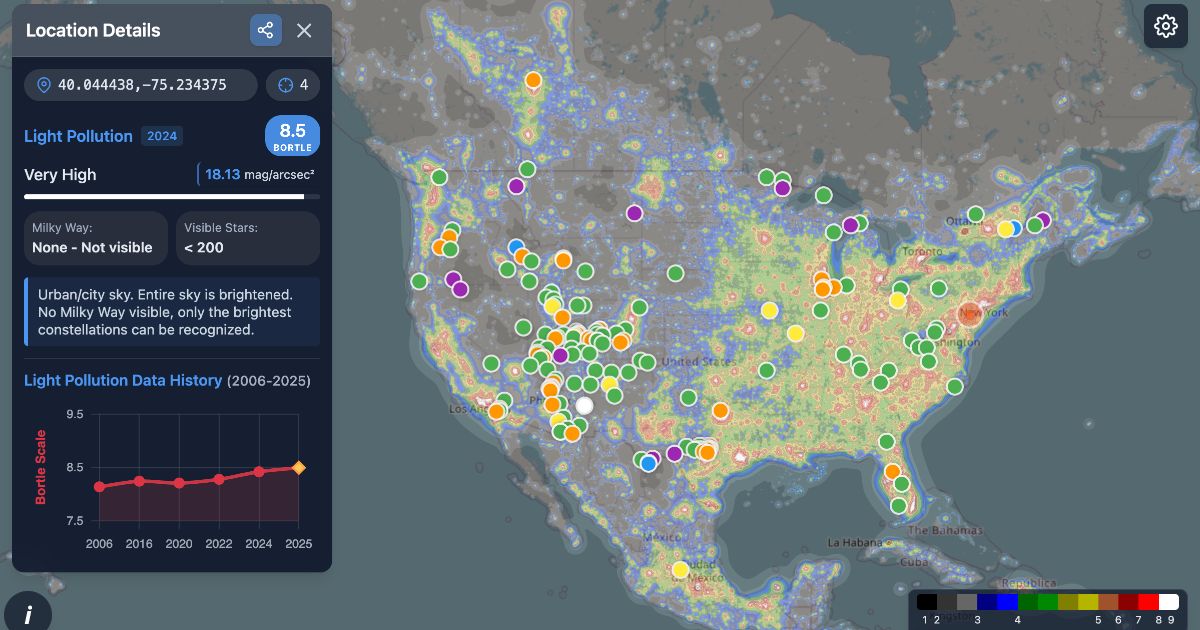
光害マップ|ボートルスケールで見る星空の暗さ (2026)
2026年版の最新光害マップ。世界中の空の暗さをボートルスケールやSQMでリアルタイムにチェックし、日本を含む天の川やオーロラ観察に最適なスポットを見つけましょう。
lightpollutionmap.appDifferences Between Naked-Eye Viewing and Photography
On any given night, the Milky Way is easier to capture in a photograph than it is to see with the naked eye. The reason is straightforward: a camera can gather light over seconds to tens of seconds, pulling out star clusters and dark nebulae that your eyes perceived as nothing more than a faint haze. I have lost count of the nights when I thought "the Milky Way looks faint tonight" only to see its luminous spine leap off the camera's rear screen.
Here is how the two experiences differ:
- Sensitivity
Even fully dark-adapted eyes struggle against moonlight and Light pollution. A camera, with adjustable exposure time and ISO, has a clear advantage.
- Required conditions
Naked-eye observation essentially demands a dark site and a moonlight-free sky. Photography benefits from the same conditions but retains some ability to record the Milky Way even when the naked eye cannot make it out.
- Preparation
Naked-eye observation is light on gear. Photography calls for a camera, tripod, and wide-angle lens. For fixed-tripod shots, the Rule of 500 provides a starting point for maximum exposure time: about 31 seconds at 16 mm, about 20.8 seconds at 24 mm. Bear in mind that the Rule of 500 is a beginner-friendly approximation, and zooming in may reveal slight star trails.
A practical starting point for fixed-tripod shooting is f/2.0-2.8, ISO 1600-6400, 15-30 seconds. Even with the camera's advantage, moonlight remains the enemy -- around full moon the sky brightens enough to kill contrast, and the Milky Way loses its three-dimensional texture. Dark skies and favorable moon conditions remain the foundation for photography too.
Paradoxically, beginners often find their first success through photography rather than naked-eye observation. On a night when the Milky Way is barely visible to the eye, pointing a wide-angle lens skyward with proper exposure settings can reveal the galactic band clearly in the image. That moment of realization -- "this faint streak really is the galaxy I am standing inside" -- is a large part of what makes Milky Way photography so rewarding.
What the Milky Way Actually Is
A one-minute refresher on what you are looking at. The Milky Way is our own galaxy, the Milky Way Galaxy, seen from the inside. The galaxy is a disk roughly 100,000 light-years across and about 1,000 light-years thick. Countless stars and interstellar material are packed into that disk, and we sit inside it, about 30,000 light-years from the center, looking along the plane. That is why it appears as a band of concentrated stars across the sky.
The band looks dense and bright in summer because our nighttime sky faces the galactic center near Sagittarius, where stars are most tightly packed. In autumn and winter, we face the galaxy's outer edge, and the band becomes thinner and fainter. The National Astronomical Observatory of Japan's nationwide Milky Way survey campaign describes the Milky Way as the combined light of innumerable stars in the galactic disk appearing as a luminous band.
So the Milky Way that moonlight can obscure is not some wispy cloud -- it is a cross-section through a galaxy containing roughly 200 billion stars. Keeping that in mind changes the feeling when a faint band rises on a dark night. The reason it only reveals itself under the right conditions is that its light is genuinely that delicate.
The Bottom Line First: When Is the Milky Way Easiest to See?
The Dense Summer Milky Way
The prime window for "Milky Way season" runs from late June through early November. Within that range, beginners will have the easiest time from July through September. The reason is simple: during those months the most photogenic section of the Milky Way climbs to a comfortable altitude while the evening is still young.
The summer Milky Way looks dense and wide because we are facing the galactic center in the direction of Sagittarius. The Milky Way Galaxy is a disk-shaped structure, and looking toward the densely packed center raises both the brightness and the apparent width of the band. When we face the outer edge in other seasons, the same Milky Way appears thinner and fainter. Summer evenings make it easiest to think "so that is the Milky Way" precisely because of this directional difference.
In practice, July through September is the most manageable period. After astronomical twilight ends, the dense region from Sagittarius through Scorpius is well placed, and the naked eye can pick up the band's presence. Observers at lower latitudes -- for example, southern Honshu (Japan's main island) and farther south -- gain a slight advantage because the galactic center reaches a higher altitude, but in my experience the factors covered in the previous section -- darkness and moonlight -- matter far more than latitude.
The Fainter Milky Way in Spring, Autumn, and Winter
An important point to avoid misunderstanding: the Milky Way is not a summer-only phenomenon. The galactic band stretches across the sky year-round. What changes with the seasons is the direction we face, and that dramatically alters how it looks.
In spring, the dense summer section has not yet risen during the early evening hours. The opportunity window centers on the predawn eastern to southeastern sky. Photographically, the composition of the Milky Way rising from the low horizon can be striking, but for naked-eye observers spring is a trickier season.
From autumn into winter, our line of sight shifts toward the galaxy's outer edge, so the band becomes thin and pale. The Milky Way does not disappear, but instead of the wide white river of summer, you are looking for a slender streak that only emerges on nights of excellent transparency. Winter skies tend to be clear and the stars are beautiful in their own right, but for Milky Way viewing specifically, it is not the most beginner-friendly season.
Knowing this distinction keeps things tidy: "Summer is the season for the dense Milky Way" and "the other seasons offer a view too, just a very different one." The reason Milky Way viewing gets so much attention around Tanabata and summer vacation in Japan is not purely cultural -- the Milky Way genuinely looks more dramatic during those months.
Position at 21:00 by Season
Getting a feel for where the Milky Way sits at a given hour eliminates a lot of confusion. A common misconception is that on the night of Tanabata the Milky Way is directly overhead. In reality, around 21:00 in early July the dense core is low in the east, not yet high in the sky. As the hours pass, it tracks from east to southeast to south to southwest.
Here is a rough sketch of the Milky Way's position at 21:00 by season:
- Summer: Becoming prominent from east to southeast; as the season advances the core rides higher
- Autumn: The band tilts toward the south-southwest and sits higher but feels thinner than in summer
- Winter: A thin, faint band traceable from near the zenith toward the north
- Spring: The dense summer section is rising in the predawn eastern to southeastern sky
Keeping this "21:00 snapshot" in your head tells you which direction to face. In early July at 21:00, staring straight up will not find it -- scanning the low eastern sky works much better. As summer deepens, the core sits higher at the same clock time, so August is easier than July and early September easier still for early-evening viewing.
Why Moon Phase Matters: The Advantage of New Moon
Moon Phase Basics
Moon phase matters for Milky Way viewing because the moon is a powerful natural light source. It is not as harsh as a streetlight, but it is more than bright enough to wash out the entire sky with a gentle glow. Because the Milky Way is inherently faint, even a small increase in sky brightness destroys the contrast, and the band's outline melts away to the naked eye. In photos the effect is the same: blacks lose depth and the sense of dense star fields weakens. Binoculars can help the band pop one step more clearly.
Moon phase counts how many days have elapsed since the new moon. As explained on the National Astronomical Observatory of Japan's FAQ, new moon is phase 0, first quarter about 7, full moon about 15, and last quarter about 22. The moon completes one cycle in roughly 29.5 days, so keeping this loop in mind lets you predict when dark nights will come around.
For Milky Way hunting, new moon is the winner. Around new moon, the moon sits roughly in the same direction as the sun, so it does not linger in the nighttime sky, giving you a long stretch of genuinely dark hours. Around full moon, by contrast, a large bright moon occupies the sky for most of the night -- a clear disadvantage. When beginners say "it was clear but I could not see the Milky Way," the cause is often moonlight rather than clouds.

「月齢」ってなに?なぜ小数がつくの? | 国立天文台(NAOJ)
「月齢」は月の満ち欠けの状態を知るための目安になる数字で、新月から何日経過したかを表しています。新月を0として1日に1ずつ数を増やしていきます。
www.nao.ac.jpReading Moonrise/Moonset and Twilight Times
In practice, checking moon phase alone is not enough. What truly matters is how the moonrise and moonset times overlap with the time when the sky becomes fully dark -- the end of astronomical twilight. Even during a favorable moon phase, a slender moon lingering in the sky during your observation window will brighten that part of the sky. Conversely, near full moon there may still be a few hours of darkness after the moon sets -- and that is your window.
This becomes obvious at the observing site. The sky after sunset is brighter than it looks; stars start appearing, but faint structures like the Milky Way remain buried. The real show begins after astronomical twilight ends. In Tokyo in July, that is roughly around 20:30 as a reference, though the exact time depends on latitude and date. While the sky still holds a blue tinge, bright first-Magnitude stars are visible but the faint Milky Way is not yet competitive.
⚠️ Warning
In practice, selecting a window where "new moon plus or minus three days" overlaps with "after twilight ends and before moonrise, or after moonset" significantly reduces the chance of a wasted trip. Thinking in terms of extracting a dark time window works better than circling dates on a moon-phase calendar.
I find that checking moonrise and moonset times alongside the moon-phase calendar cuts down on missed nights considerably. Even during the new-moon window, a thin crescent lingering in the western sky right after sunset is slightly unfavorable. Flip that around: when the moon phase is more advanced but the moon does not rise until the predawn hours, the earlier part of the night is perfectly usable. The Milky Way's visibility depends less on what date it is and more on what time of night the sky is actually dark.
New Moon Example: July 25, 2025
As a concrete reference point, July 25, 2025 is a new moon. Late July is also when the dense summer Milky Way becomes increasingly easy to work with during evening hours, as discussed earlier. The alignment of new moon and peak season makes this a strong candidate for Milky Way viewing.
What makes this date handy is that "summer prime time" and "minimal moonlight" line up simultaneously. Late July in particular sees the Sagittarius core gaining visual impact, and if the rainy season (tsuyu) has cleared, observation satisfaction tends to be high. Atmospheric transparency and cloud cover still play their part, but at a minimum the moon factor is nearly eliminated, making this a practical starting point for planning.
You do not need to target July 25 exclusively. Stretch the window about three days on either side of new moon, then identify the hours after twilight when the moon is below the horizon. That gives you a workable set of candidate nights. The summer Milky Way gains presence suddenly when conditions click. A dark site, a sky that has fully transitioned to night, and no moon. That convergence is what makes the new-moon window so valuable.
Three Conditions for Choosing an Observation Site
Light-Pollution Maps and Bortle Class
The first non-negotiable condition for Milky Way viewing is low Light pollution. Whether you can see it with the naked eye depends on this single factor more than on any piece of gear. In urban areas the entire sky tends to be lifted into a whitish glow, and even on a clear night the Milky Way's band disappears into the background. Moving to the suburbs increases the star count, but reaching the stage where the Milky Way stands out as a distinct band requires darker skies still. Mountains, plateaus, coastlines, and islands are favorable not simply because of altitude but because artificial light is scarce and the sky stays dark all the way to the horizon.
As a practical benchmark, aiming for Bortle class 5 or lower makes site selection straightforward, and even first-timers can find the Milky Way without trouble. A light-pollution map is the easiest tool for gauging this, and once you get used to reading the colors, candidate sites jump out quickly. In broad terms, yellow is borderline, green to blue is favorable. A yellow zone can still yield results if other conditions align, but naked-eye visibility drops a notch. For a first outing, prioritizing green-to-blue areas on the map reduces the odds of disappointment.
When reading Bortle overlays, judging from a single point on the map can mislead you. A large city nearby will brighten the sky selectively in that direction. I always check not just the darkness at the destination but also which compass direction the nearest city lights lie. Adjusting your standing position can make a surprising difference; simply turning your back to the brightest city cleans up the contrast in your target sky. Mountain valleys and highland plateaus are strong partly because of this topographic advantage: it is easier to put bright directions behind you.
Checking Terrain and Compass Bearing
Darkness alone is not sufficient. A wide-open sky changes the impression of a faint band dramatically. The dense summer Milky Way rises from the low horizon, so trees at the forest edge, ridgelines, buildings, or streetlights that clip your line of sight make it suddenly harder to spot. The "it is dark but I cannot see anything" failure at a site is more often caused by obstructed terrain than by Light pollution. Binoculars can help sharpen the band one step further. A parking lot surrounded by tall trees can shrink your usable sky far more than you expect.
The compass direction to prioritize is a dark southern to southeastern sky. The dramatic summer Milky Way corresponds to the galactic center, and it passes through that part of the sky. A mountain wall rising to the south or city glow spreading to the southeast means you are likely to miss the best portion. Conversely, at a coastline or plateau where the sky is dark and unobstructed all the way from the horizon, the Milky Way's rise is strikingly beautiful. The composition of the band climbing from low on the horizon is powerful both in person and in photographs, and this is where site selection directly shows its effect.
Shirabiso Highland (Nagano Prefecture, Japan) at roughly 1,900-1,918 m altitude, for example, benefits from an unobstructed view toward the Southern Alps, and Nobeyama Plateau's Hirasawa Pass (also Nagano) is well known for its wide horizon and excellent low-altitude transparency. These sites are strong not merely because they are "dark" but because the sky remains open in the direction you want to look. Urban areas, by contrast, combine Light pollution with direct glare from buildings and streetlights, making Milky Way observation tough. When searching near a city, prioritize elevated viewpoints, coastal areas, or the edges of large farmlands within the same region -- differences in how much sky is open shift your priorities.
Safety and Facilities Checklist
A site may be excellent for observing, but if you cannot stay there comfortably after dark, its practical value drops. The basics to check are: Can you park? Is there a restroom? Do you have cell reception? Is the area accessible and open to visitors at night? Choosing a site purely for its dark skies can lead to turning around on arrival. In practice, these logistical factors weigh heavily.
Okutama Lake (western Tokyo, Japan), for instance, has free parking and restroom facilities near the Ogouchi Dam, and is accessible by bus in about 15 minutes from JR Okutama Station. However, the dam-side parking lot has posted gate hours of 6:00 to 21:00, so "dark and convenient" is not always a safe assumption for nighttime use. Highland sites like Shirabiso often have lodges or campgrounds, but you need to factor in the mountain roads required to get there.
When facilities are part of the equation, beginners benefit most from sites that are "easy to park at, close to a restroom, and do not require anxious middle-of-the-night relocation." Site selection might sound romantic, but it is ultimately practical. Dark, open, and with a dark southern to southeastern sky -- a site that meets those three criteria and also allows safe overnight stays is, in the end, the strongest observation location.
Finding the Milky Way: Direction, Timing, and App Use
How Position Changes with Season and Time
A common stumbling block when searching for the Milky Way is looking toward the south at any hour and expecting to see it. In reality, position shifts substantially with both season and time of night. The dense galactic-center region sits low during early evening hours in summer, then climbs higher and drifts west as the hours pass.
Using early July as a benchmark, around 21:00 the dense core is visible low in the east. From there, the band's best viewing position tracks through southeast, south, then southwest as the night progresses. When first-timers say "I could not find it," the issue is often not the wrong compass bearing but rather that they looked a bit too early or a bit too late. Rather than fixating on one direction, adjust your gaze with the clock.
Timing the start of your search matters too. The Milky Way is lost in the bright sky right after sunset and does not emerge as a visible band until astronomical twilight ends. Taking Tokyo in July as an example, that is roughly after 20:30, though this is illustrative only -- the actual time varies with latitude and date, so check the twilight time for your observing site on the day. While the sky still holds traces of blue, bright first-Magnitude stars are visible but the faint Milky Way is at a disadvantage.
Low-altitude viewing is also delicate. The dense region rises near the horizon, so not just cloud cover but transparency and low-altitude haze affect the impression. An otherwise clear sky with a whitish bloom along the southeastern horizon is not unusual. Many of the nights when I thought "the sky is perfectly clear yet the band is not showing" turned out to have low-altitude moisture or thin haze as the culprit.
Using the Summer Triangle as a Guide
If you are unsure where to look, start with the Summer Triangle. Vega in Lyra, Deneb in Cygnus, and Altair in Aquila form a large, unmistakable triangle in the summer sky. The Milky Way runs near this asterism, making it a reliable entry point even if you have not memorized individual constellations.
The clearest approach is to start at Deneb in Cygnus and trace the white band southward. The area around Deneb sits over the Milky Way like a swan in flight, and in dark skies you can sense the dense streak of stars. Sweep your gaze south from there and the band gradually widens and brightens. Following the direction where "the thin band becomes thicker" leads you naturally toward the galactic center.
Another landmark is the area around Scorpius and Sagittarius. This is where the summer Milky Way is densest, a bustling stretch of nebulae and star clusters. From the red star Antares in Scorpius down toward Sagittarius, even the naked eye can sense a jump in star density, and at a dark site this region serves as a beacon for locating the Milky Way's core. You are looking for a place along the low southern sky where starlight is not scattered randomly but gathers into a band-like concentration.
💡 Tip
Find the Summer Triangle first, confirm the band around Deneb, then trace it southward toward Sagittarius and Scorpius. This sequence lets you build a mental map of the sky's structure.
Using Sky Tonight for On-Site Confirmation
When you are uncertain about directions at the site, a planetarium app is a powerful ally. Even I rely on an app like Sky Tonight when reading the sky from an unfamiliar location. The key is not just opening the app but also checking the time and the moon's position at the same time.
The basic workflow is simple. Turn on your smartphone's location services so the app calibrates to your local sky. Launch the app and hold the phone up in AR mode to overlay constellation and Milky Way positions onto whatever you are facing. For someone still learning the sky, this "what I see matches the chart" sensation is enormously helpful.
The search function is handy: type "Milky Way" to highlight its position and cut down on confusion. If the overlay is hard to read, searching for Sagittarius or Scorpius and using them as landmarks is sometimes faster in the field -- because while the Milky Way itself is faint, constellation positions are relatively easy to confirm.
For time-based checks, flipping between 21:00, 23:00, and predawn reveals how the sky moves. Dragging Sky Tonight's time slider shows the Milky Way tracking from low in the east to the south and then tilting west -- a visual preview that pays dividends at the site. Seeing the motion in the app beforehand is far easier than trying to imagine it, and lets you judge "it is still low" or "it will reach the south soon" with confidence.
An often-overlooked detail is the moon's position and altitude. Moon phase was covered earlier, but at the site you want to know not just "is the moon out" but in which direction and how high. Sky Tonight displays the moon on the same screen, so you can quickly check whether it overlaps with the Milky Way's direction.
A practical on-site sequence: after twilight ends, open the app, scan the eastern to southeastern sky, locate the Summer Triangle, then drop your gaze toward Sagittarius and Scorpius. Observers who feel lost tend to fare much better when they use the app to lock in the spatial relationships first, then follow up with the naked eye.
Beginner Observation Procedure: Pre-Departure Checklist
Preparation List
Success with Milky Way viewing depends more on what you check before leaving home than on effort at the site. As a beginner, sequentially narrowing down moon, weather, location, and time eliminates most guesswork. In my experience, heading out with any of these four still vague tends to produce the frustrating result of "the sky does not look bad, yet I cannot see it."
The backbone is selecting a night near new moon. The target window is about three days on either side of new moon, prioritizing nights with minimal moonlight. Do not stop at the moon phase alone -- check the moonrise and moonset times as well, or moonlight will bury the Milky Way. Even a half moon or thin crescent, if above the horizon during your planned observation time, suppresses the faint band more than you might expect. Consulting not just a moon-phase calendar but also the specific "what time does the moon rise and set tonight" data reduces wasted outings.
Next, nail down clear skies, cloud cover, and transparency. Checking only the overall precipitation probability is insufficient; the Milky Way is a faint target, and even thin clouds or high humidity under otherwise clear skies degrade the impression. In practice, cross-checking multiple weather apps is efficient -- combining a general forecast, a cloud-cover forecast, and satellite imagery gives a more reliable picture. Apps often disagree slightly on cloud estimates, so picking nights where multiple sources agree on "low clouds after dark" is more dependable than trusting any single one.
For location, as discussed, darkness is the top priority. Rather than relying on intuition, using a light-pollution map is faster. Setting a baseline of Bortle 5 or lower, ideally 4 or lower, raises the hit rate even for first-timers. Highland sites like Shirabiso (Nagano Prefecture, Japan) -- high altitude with an open southern horizon -- are strong candidates, as are wide-sky areas like Nobeyama Plateau (also Nagano). Suburban sites, on the other hand, may look dark on the ground while surrounding city lights still lift the sky, making them less favorable than they appear.
For timing, target the window after astronomical twilight ends and before moonrise, or after moonset. "Right after sunset" is not the same as "dark." Waiting until the sky is truly dark raises the Milky Way's contrast by a clear step. As a rough urban reference, astronomical twilight in Tokyo ends around 20:30 in July, but this is only an example -- the actual time varies by year and latitude. Layering the moon condition on top, you are looking for either the hours between twilight's end and moonrise, or the hours between moonset and dawn.
A practical pre-departure checklist:
- Pick dates within three days of new moon; confirm moonrise and moonset times
- Check clear-sky forecasts, cloud cover, and transparency across multiple weather apps
- Compare candidate sites on a light-pollution map, prioritizing Bortle 5 or lower
- Target the window after astronomical twilight ends and before moonrise, or after moonset
- Set your smartphone to red-screen mode at minimum brightness for on-site dark adaptation
- Prepare a red-light flashlight to avoid white-light use
- Settle the logistics in advance: parking, restrooms, warm clothing, insect repellent, and a safe return drive
ℹ️ Note
Beginners tend to head out with just "near new moon, clear, dark site." In reality, your actual observation window does not become clear until you add moonrise/moonset times and the end of astronomical twilight into the picture.
Conduct and Etiquette at the Site
The most important thing when you arrive is not to wander around looking up right away. First, sort out your footing and surroundings, then let your eyes adapt to the dark. Unlike hunting for bright constellations, Milky Way viewing is dramatically affected by whether your eyes are dark-adapted. You will probably think "the sky seems unremarkable" at first, but after 15 to 30 minutes of avoiding stray light, the band's faint presence begins to surface.
The fastest way to ruin dark adaptation is white light and a bright smartphone screen. If you need your phone, switch to red-screen mode at minimum brightness and keep map and star-chart checks to a minimum. Flashlights and headlamps set to white are startlingly bright -- they blow not only your own adaptation but that of every other observer nearby. At stargazing sites, using a red light is standard practice, and pointing it downward is essential.
At drive-in sites, headlight management is part of the etiquette. Simply repositioning a car or preparing to leave can send headlight beams sweeping across the observation area, ruining the sky for everyone. Backing in on arrival or planning your exit direction in advance makes a tangible difference. The quieter the site, the more these small courtesies preserve the quality of the experience.
On the safety side, choosing a spot purely for its view can lead to trouble after dark. Terrain is harder to read at night; steps, ditches, muddy patches, and crumbly road shoulders become invisible. Consider whether parking is permitted, whether restrooms are available, whether the footing is stable, whether you have adequate warm layers and insect protection, and whether the return drive is manageable. In mountain areas, even midsummer nights can drop in temperature noticeably, and the chill from standing still and staring at the sky for an extended period is more than most people anticipate.
Keeping quiet at an observation site also contributes to the quality of the experience. Loud conversation, playing music, and repeatedly opening and closing car doors cut through the night air. Stargazing time is valued not only for its darkness but also for its silence. I have found that even with identical sky conditions, less ambient light and noise makes a profound difference in observation satisfaction. A well-mannered site is one you want to revisit.
Shooting the Milky Way: Fixed-Tripod Basics and Gear
Your First Fixed-Tripod Recipe
For a clean first Milky Way image on a fixed tripod, starting with a wide-angle lens is the straightforward choice. In 35 mm equivalent terms, 16-24 mm captures a broad swath of sky and permits longer exposures, boosting the beginner's success rate. A 50 mm lens can work, but the narrower field makes star trailing more conspicuous and composition more demanding. Start with "wide, bright, hard to blur" and your keeper rate goes up.
The baseline settings are f/2.0-2.8, ISO 1600-6400, 15-30 seconds of exposure. The Milky Way is fainter than it looks, and exposing with a daytime mindset will produce nothing. For a first attempt, I typically use a 16-20 mm class bright lens near wide open, starting around ISO 3200. On a transparent dark night you can afford to lower the ISO; in a slightly brighter sky, pulling back the exposure time keeps the sky color from blowing out.
A tripod is mandatory for fixed-tripod work. On top of that, use a remote release or self-timer to avoid the vibration of pressing the shutter button directly. Even a 2-second timer is effective. At the site, wind and slight instability in the ground translate directly into soft star images, so spread the tripod legs firmly and avoid extending the center column to its full length.
Focusing is where most beginners stumble first in night-sky photography. Autofocus tends to hunt in the dark, so the standard approach is switching to live view, zooming in on a bright star, and focusing manually. You are looking for the point where the star appears smallest and sharpest. The infinity mark on the lens barrel is not always accurate, so do not trust the engraving alone. In the dark, every operation takes longer, and the red-light flashlight mentioned earlier proves its worth here.
For color, setting white balance manually to around 4000K makes it easier to gauge the sky's blue tones and the foreground's color. Shooting in RAW gives full latitude for adjustment later, so when in doubt, RAW is always the safe choice. Long-exposure noise reduction is a matter of personal taste: enabling it slows your shooting rhythm but produces cleaner single frames. Shooting a comparison set with NR on and off helps you find the direction that suits your camera and style.
The Rule of 500 and the NPF Rule
In fixed-tripod photography, pushing the exposure too long turns stars from dots into streaks. The widely used guideline for the upper limit is the Rule of 500. The idea is simple: 500 / focal length (35 mm equivalent) = maximum exposure in seconds. Wider lenses allow longer exposures; longer focal lengths demand shorter ones.
Rough benchmarks:
| Focal length (35 mm equivalent) | Rule of 500 exposure limit |
|---|---|
| 16 mm | ~31 seconds |
| 24 mm | ~20 seconds |
| 50 mm | ~10 seconds |
These numbers are a convenient starting point. At 16 mm you can push close to 30 seconds; at 24 mm, around 20 seconds; at 50 mm, keeping it near 10 seconds helps maintain point-like stars. The "15-30 second" range suggested for initial settings absorbs this focal-length variation.
That said, the Rule of 500 is only a guideline. On a high-resolution sensor viewed at 100% or in a large print, stars may show slight trailing even at the "safe" exposure. At 50 mm especially, what looks fine on the rear LCD can appear soft when pixel-peeping. In my experience, modern high-megapixel bodies often make the Rule of 500 feel slightly generous.
That is where the NPF Rule comes in. It factors in not just focal length but also aperture and pixel pitch, yielding a tighter estimate of the exposure time at which stars remain points. The math is more involved than the Rule of 500, but the result is more trustworthy for high-resolution cameras and print-quality work. A practical workflow is to set initial exposure with the Rule of 500, then tighten toward the NPF Rule as you pursue sharper star images.
⚠️ Warning
When in doubt, cut a few seconds below the Rule of 500 result. Especially at 24 mm and 50 mm, trimming just a few seconds noticeably tightens star shapes.
Gear Combinations That Minimize Failure
At the fixed-tripod stage, the key is not the most expensive setup but building around a bright wide-angle lens and a stable tripod. An interchangeable-lens camera body is advantageous, but the factors that produce the biggest immediate difference are lens speed and tripod stability rather than sensor size. Having an f/2.0-2.8 wide-angle lens alone gives you meaningful headroom in ISO and exposure-time decisions.
The most manageable combination is a 16-24 mm (full-frame equivalent) prime or fast zoom paired with a solid tripod. Around 16 mm, fitting both the Milky Way arc and foreground scenery into one frame comes naturally, and composition is forgiving for beginners. At 24 mm the framing feels a bit tighter and the Milky Way's presence concentrates. A 50 mm lens offers interesting possibilities for cropping into a section of the band, but the reduced exposure latitude in fixed shooting lowers its priority as a first lens.
From a practical standpoint, adding a remote release and a red-light flashlight alongside the wide-angle lens smooths out on-site operations considerably. In the dark, small frustrations cascade: fumbling for a button and bumping the tripod, or blasting yourself and your neighbors with a white flashlight. These accessories are not imaging gear per se, but they improve the keeper rate.
If you begin thinking about tracked exposures, a portable Equatorial mount is an option. The Sky-Watcher Star Adventurer GTi, for instance, has a mount-head mass of approximately 2.9 kg (mount head only). Paired with a mirrorless body and a mid-size tripod, the total field weight typically comes in around 7 kg, depending on your exact configuration. With practice, setup at the site takes roughly 5-15 minutes. Regarding price, Sky-Watcher's announced suggested retail price at launch was 99,000 yen (~$660 USD, tax included, at time of release), though actual street prices vary by retailer and timing -- treat this as a reference figure.
Even so, fixed-tripod shooting does not demand a complicated gear list. Tripod mandatory, wide-angle preferred, bright lens used near wide open. Stick to that axis and the Milky Way's white band will show up in your images. I have always felt that the joy of astrophotography lies not in how much gear you own but in the moment when settings and procedure click together. When that faint light from the night sky rises on your LCD, even a single frame returns a genuine expression of the cosmos.
Common Mistakes and How to Fix Them
Typical Misreads of Conditions
The most frequent beginner stumble is deciding based on date alone: "It is Tanabata night, so the Milky Way should be visible." In practice, even on the exact date of Tanabata, if astronomical twilight has not yet ended the sky is not dark enough and the white band stays hidden. In Tokyo, twilight can end as late as around 20:30 in July, so stepping outside right after dinner may put you ahead of "star-viewing time." Layer moonlight on top and conditions tighten further. A near-full moon brightens the entire sky and strips the Milky Way of its faint contrast. Add low-altitude haze on top of that, and even the correct compass bearing will not save you -- the dense core region bleeds into the glow.
Concluding "it is not out tonight" on a night like this is a genuinely regrettable mistake. The reason you cannot see it is usually not that the Milky Way is absent but rather that "the sky is still too bright," "the moon is too strong," or "low-altitude transparency is poor." The fix is straightforward: wait a bit longer, observe after the moon sets, or hold off until the target section has climbed higher. I have seen the sky's expression transform in as little as 30 minutes to an hour at the site.
Another common pitfall is attempting the observation from a city and walking away defeated. Under strong urban Light pollution -- roughly Bortle 6-8 -- naked-eye detection of the Milky Way is extremely difficult. In a bright sky, the Summer Triangle may be visible but the faint band between its stars will not emerge. Beginners often assume "I can see stars, so the Milky Way should be out too," but there is a large gap between those two thresholds. The Milky Way cannot be found with the same mindset used for spotting bright first-Magnitude stars. To have a real chance, aim for at least a Bortle 4 suburban area, or better yet a highland, coast, or mountain valley with green-to-blue darkness.
Another classic trap is trusting altitude alone. Going high does tend to mean clearer air, but altitude by itself does not guarantee results. If city lights, factory illumination, or road lighting spread across the southern to southeastern horizon, only the sky in your target direction is brightened. Even after gaining altitude, if Light pollution pierces the direction you want to look, the benefit is thin. What matters is not just "how many meters high" but which directions are dark and whether the low sky is unobstructed. Checking surrounding city positions on a map or satellite image and reviewing the terrain's openness beforehand reduces this type of failure.
In photography, a surprising number of people assume "if the naked eye cannot see it, the camera will not capture it either." This is not necessarily true. The human eye has real limits in perceiving faint color and subtle gradients in the dark. A band that felt like "maybe a faint cloud" at the site can register clearly on a properly exposed fixed-tripod shot, revealing galactic structure and dark lanes. Conversely, pushing exposure too long in a bright sky saturates the background to a washed-out white, destroying the band's presence. When reviewing on the LCD, check the histogram to ensure it is not piling up on the right side, and keep the exposure controlled enough not to lift the sky brightness too far. On nights when the naked eye struggles, a "slightly conservative exposure" is often what saves the faint band in photographs.
ℹ️ Note
Even when your naked-eye impression is weak, the first fixed-tripod frame can change your assessment. As long as the sky is not uniformly bright and flat, there is room to locate the Milky Way on the LCD.
Dealing with Environmental Factors: Humidity, Wind, and Dew
When the sky is dark, the moon phase is right, and the compass bearing checks out yet results still disappoint, the culprit is often an environmental factor beyond weather. In summer especially, high humidity alone can sap the Milky Way's contrast even under a visibly clear sky. Distant light scatters through moist air, turning the low horizon into a sleepy white glow. In those conditions the band looks fainter to the naked eye, and photographs come out with muted definition. The gap between a crisp, transparent night and a sticky, humid one is dramatic -- the same site can feel like two different skies.
Wind is another factor that is easy to overlook. A light breeze can be comfortable, but stronger wind introduces fine vibrations into the tripod and lens tip, softening star images. At lakes and coastlines, reflections in the foreground are disrupted too, and swaying vegetation can drag down the overall composition. You may not notice the vibration at the moment of capture, but back home at 100% zoom "everything is slightly soft" is a familiar disappointment. For fixed-tripod work, spreading the legs firmly, removing or securing straps that catch the wind, and using a remote release or self-timer to eliminate press-vibration all improve the keeper rate noticeably.
The most insidious summer hazard at highland and lakeside sites is lens dew (condensation). Everything may be fine when you start shooting, only for every frame to suddenly turn hazy partway through the session. This is not a focus slip -- a thin layer of moisture has settled on the front element, killing contrast. It is hard to spot with the naked eye and may look like nothing more than "a slightly soft rendering" on the rear LCD, which delays detection. When sharpness drops suddenly on a summer night, dew is my first suspect. If wiping the glass clean only buys a minute before it fogs again, the ambient moisture is winning.
The best defense is choosing a dry night in the first place. Beyond that, use the car body or terrain features to block direct wind and reduce equipment vibration. For dew, a lens heater is the most reliable solution; as a lighter alternative, anti-fog treatments or lens warmers help. Simply checking the front element periodically during the session prevents wasted frames. The Milky Way is sensitive not just to sky conditions but to tiny changes on the surface of your gear. Even a perfect sky can fall apart if humidity, wind, or dew goes unchecked. Instead of concluding "I picked the wrong site," diagnosing these environmental factors can bring the next outing dramatically closer to success.
Summary: A Quick Decision Flow for Tonight's Milky Way
When judging tonight's Milky Way prospects, work through season, moon phase, location, weather, and time of night in that order and the decision falls into place. If the season and sky position align, moonlight can be avoided, a site with dark southern-to-southeastern skies is available, and transparent clear weather cooperates, you have a viable night. Rather than trying to perfect everything in one go, use a moon-phase calendar, a light-pollution map, and a stargazing app to narrow candidate dates and sites -- that is the fastest path. For photography, building one successful experience with wide-angle fixed-tripod shooting before reaching for complexity pays off. The finer points of gear settings, smartphone astrophotography, composition techniques, and the step up to tracked shooting are covered in the linked articles, so expanding from here keeps the learning curve manageable.
Related Articles
The Bortle Scale Explained: What Classes 1 Through 9 Really Mean
The Bortle Scale Explained: What Classes 1 Through 9 Really Mean
When searching for dark-sky sites, you'll encounter terms like the Bortle Scale, SQM, and NELM, but the numbers alone don't always convey how dark a sky actually is. This guide breaks down how to read night-sky darkness for beginners heading out to stargaze, as well as anyone who stares at light pollution maps and still isn't sure where to go.
When and Where to See the Milky Way: Season, Direction, Location, and Moon Phase
When and Where to See the Milky Way: Season, Direction, Location, and Moon Phase
The Milky Way isn't something that only appears during summer festivals -- it's there all year round. What really determines whether you'll actually see it comes down to five factors: season, direction, location, moon phase, and weather. Get these right, and even beginners have a realistic shot. This guide is built for anyone wondering 'can I go see it tonight?' and covers the shortest path from naked-eye observation to fixed-tripod photography.
How to Start Astrophotography: Camera Settings for Smartphones and DSLRs
How to Start Astrophotography: Camera Settings for Smartphones and DSLRs
Star photography might seem daunting at first, but with a fixed tripod setup — whether you're using a smartphone or a mirrorless camera — you can nail your first shot tonight. This practical guide is for beginners who aren't sure what settings to use, walking you through exact values for ISO, shutter speed, aperture, and focal length in the order you'll actually need them in the field.
Is the Achi Village Night Tour Worth It? What Japan's No. 1 Stargazing Claim Really Means and How to Prepare
Is the Achi Village Night Tour Worth It? What Japan's No. 1 Stargazing Claim Really Means and How to Prepare
On a night when conditions align, the sky over Achi Village in Japan is genuinely breathtaking. That said, the 'No. 1 in Japan' label traces back to a 2006 Ministry of the Environment observation study, and what you actually see depends heavily on cloud cover, moonlight, and the season.