
Telescopes for Viewing Saturn's Rings: Aperture and Magnification Guidelines (2025-2026)
When it comes to seeing Saturn's rings, aperture matters more than magnification. An aperture around 50-60mm may let you confirm the rings exist under favorable conditions, but the ring angle for a given year, Seeing, and observation altitude all heavily influence what you actually see. For a dependable experience, 80mm-class telescopes and above are the practical starting line. This article walks through equipment choices with the current ring angle in mind, so beginners can get from setup to ring confirmation without unnecessary detours.
Which Telescope Shows Saturn's Rings? The Short Answer
Here is the bottom line up front. A 50-60mm aperture may let you confirm the rings exist, but observing conditions can make this much harder or easier. The practical threshold where beginners tend to come away satisfied is the 80mm class. To explore ring separation and surface details on the planet itself, 100-150mm class instruments give you real working room. For magnification, roughly 30x gets you an existence check, 100x delivers a clearly recognizable view, 120x starts to bring out subtlety, and 200-250x rewards you only on nights with excellent Seeing. AstroArts has a useful overview of yearly ring geometry, though cross-referencing with primary sources like the National Astronomical Observatory of Japan is always a good idea (reference: https://www.astroarts.co.jp/special/2025saturn/index-j.shtml).
What Each Aperture Class Actually Shows You
50-60mm class instruments sit at the entry-level floor. On a calm night at around 30x, you can tell Saturn is not just a point of light -- something extends to either side. That moment of recognition has real power. However, during years like 2025 when the rings appear razor-thin, difficulty climbs. Even pushing to 100x, expect minimal separation between the rings and the planet's disk.
80mm class changes the game noticeably. At 30x the planet is easy to acquire, and the image holds up well when you push to 100x. From my own experience, 80mm is roughly where "I saw it" turns into "I enjoyed it." Even in 2025's thin-ring season, this aperture gives you a realistic shot under good conditions, and once the rings begin opening again into 2026, it becomes the sweet spot for first-time satisfaction.
100-150mm class gives you breathing room to truly observe Saturn. Ring outlines stabilize around 100x, and at 120x surface features start to emerge. On quiet nights you can meaningfully push toward 200x, and depending on conditions, hints of the Cassini Division come within reach. Whether high magnification pays off still depends entirely on Seeing, but this is the aperture range where the difference in glass size starts telling in fine detail work.
Think "Usable Power," Not "Maximum Power"
A common misconception about Saturn is that higher magnification automatically means a better view. In practice, pushing high magnification on a small-aperture telescope produces a dimmer, softer image than using moderate power on a larger instrument. Manufacturer guides repeat this point consistently: aperture outranks magnification when choosing a telescope.
💡 Tip
Extreme magnification figures like "300x" or "450x" in advertising do not translate directly to Saturn performance. Without the aperture and mount stability to support those numbers, the image just gets larger, mushier, and shakier.
The practical magnification tiers are straightforward. Around 30x works well for acquisition and initial ring detection. 100x is the workhorse range where Saturn's character comes through most clearly -- accessible for beginners. 120x pushes a bit further, sharpening the contrast between rings and disk. 200-250x looks tempting on paper, but it only delivers on nights when the atmosphere cooperates, so it never becomes a default setting.
It Won't Look Like a Photo -- But the Rings Are Genuinely Stunning
Worth setting expectations here. Visual Saturn does not match the vivid colors and crisp detail of long-exposure, processed astrophotography. What you see through the Eyepiece has subdued color and far more delicate contrast. And yet, the moment the rings separate from the disk in your field of view carries something no screen can replicate. I photograph planets regularly, and the high-resolution Saturn on my monitor is a different experience entirely from the quiet jolt of seeing that small ringed shape with my own eye. If you measure against photography, visual observing will seem understated. But the first time you confirm "that planet has rings" for yourself, the impact belongs to visual observing alone.
How Saturn's Rings Work -- and Why 2025-2026 Makes Them Harder to See
Saturn's rings do not look the same every year because the ring plane is a tilted disk. The rings are inclined about 26.7 degrees relative to Saturn's orbital plane, and as Saturn takes roughly 29.5 years to orbit the Sun, the angle we see from Earth shifts slowly. In wide-open years the classic ringed shape is unmistakable; in shallow-angle years the rings shrink to a thin line across the disk.
A helpful mental image: picture a CD or vinyl record tilted slightly. Face-on, the circular surface is obvious. Edge-on, only a sliver remains visible. Saturn's rings work the same way -- the steeper the angle, the easier to see; the shallower the angle, the harder the observation. Because the rings are primarily thin sheets of ice particles, they virtually vanish when viewed edge-on.
The "Ring Disappearance" That Happens Every ~15 Years
This edge-on phase arrives roughly every 15 years. As described by Gunma Astronomical Observatory and the NAOJ Ephemeris Computation Office, 2025 is one of those milestone years. On March 24, 2025, the rings align exactly edge-on as seen from Earth, producing a ring disappearance. The rings do not physically vanish -- their apparent thickness simply becomes so small that they are nearly invisible.
During this period, even if you successfully acquire Saturn in your telescope, you may find yourself thinking "where are the rings?" The planet itself does not dim; only the rings become hard to see. Experienced planetary observers pay close attention to these yearly cycles. In my own sessions, the normally unmistakable ringed planet takes on a strangely quiet appearance in years like this.
2025 also sees a near-disappearance phase in autumn through early winter. AstroArts and other sources report that around late November 2025, the ring tilt drops to roughly 0.45 degrees -- a near-edge-on state. Since specific values like this can depend on individual analyses, cross-checking with primary sources such as the NAOJ Ephemeris Computation Office is recommended (reference: https://eco.mtk.nao.ac.jp/koyomi/topics/html/topics2025_1.html).
The key takeaway is that the March 24 disappearance does not mean conditions bounce back quickly. Throughout 2025, ring tilt stays extremely shallow. Saturn observation difficulty hinges more on ring angle than on brightness -- understanding that structure changes how you set expectations.
ℹ️ Note
As a visual shorthand: years with a large ring tilt = the ellipse looks fat; years with tilt near zero = it approaches a single line. Even with the same telescope, shallow-angle years are a step harder.
土星の環の消失 - 国立天文台暦計算室
eco.mtk.nao.ac.jpFrom Summer 2026, Conditions Gradually Improve
The difficult stretch is not permanent. As AstroArts' 2025-2026 Saturn coverage notes, from summer 2026 onward Saturn's southern hemisphere begins facing Earth, and the rings slowly open back up. The change is not dramatic overnight, but compared to 2025's near-line appearance, the trend is steady improvement.
This means the same telescope will feel different in 2025 versus 2026. In 2025 you may find Saturn easily yet struggle to pick out the rings. By late 2026, the familiar ringed shape starts coming back. Without knowing about yearly difficulty swings, it is easy to feel disappointed -- but once you understand the cycle, watching the image evolve becomes part of the appeal.
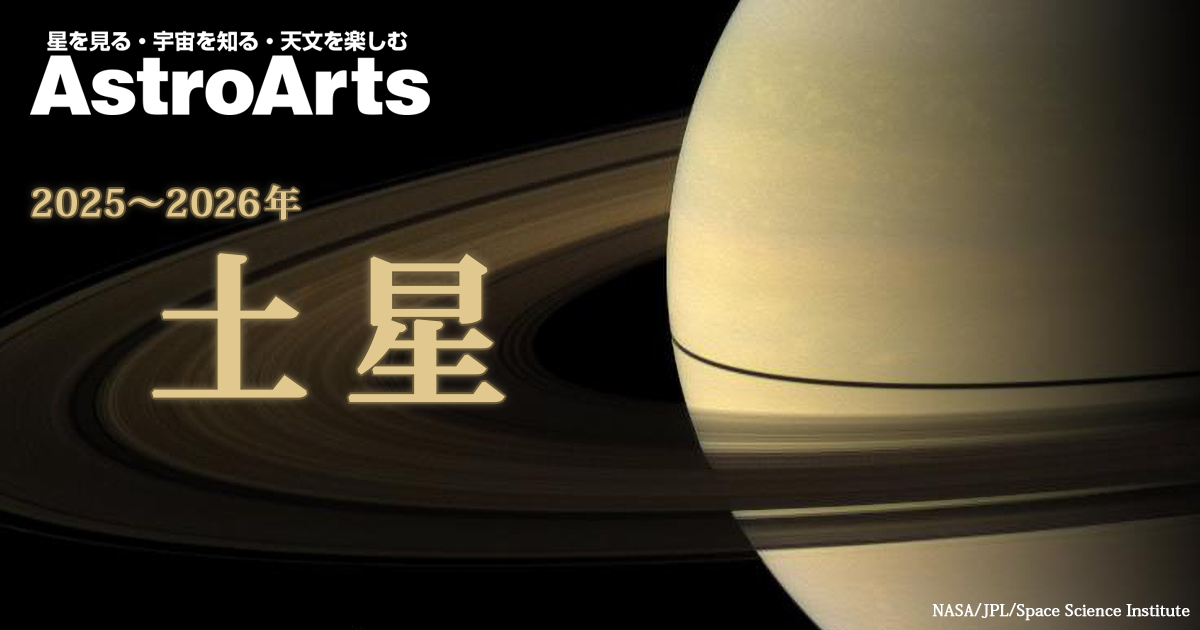
【特集】土星(2025~2026年) - アストロアーツ
2025年から2026年の土星は9月~1月ごろに観察シーズンを迎えます。明るいので街中でも簡単に見つけられます。天体望遠鏡で観察すると細い環が見えます。衛星タイタンや、近くにある海王星も探してみましょう。
www.astroarts.co.jpThe Planet Is Easy to Find, But Ring Observation Is a Separate Challenge
During 2025-2026, Saturn sits near the Pisces-Aquarius boundary and shines at roughly Magnitude 1, making the planet itself fairly easy to spot even from urban areas. Finding it as a bright, star-like point with the naked eye is not especially difficult.
Here is the catch, though. Ease of finding and ease of seeing the rings are two different things. At Magnitude 1, acquisition is straightforward, but in a thin-ring year like 2025, resolving ring detail through the Eyepiece becomes harder. From a city you can locate Saturn without much trouble, yet thin-ring observation demands atmospheric stability and telescope headroom that a bright planet alone does not guarantee.
That is why 2025-2026 Saturn is best understood not as an "invisible year" but as a year where what you see changes depending on the cycle. Saturn near ring disappearance and Saturn with wide-open rings are the same planet showing completely different faces. When you fold in that periodic variation, Saturn observation stops being a one-time event and becomes something you want to follow across years.
Aperture Comparison: What Changes at 50mm, 60mm, 80mm, 100mm, and 150mm
50-60mm Class: Primarily Ring Existence Confirmation
A 50-60mm instrument works as a Saturn entry point, but its role is clearly defined. The realistic target is confirming that Saturn is a ringed object -- and not much beyond that. At around 30x, once the image stops being a simple point and shows something extending to each side, you have captured Saturn's essence. Even a small refractor delivers a genuine thrill in that moment. The instant Saturn enters the Eyepiece as a "planet with shape" rather than just another star, the first impression is remarkably powerful.
Pushing this aperture to 100x does not suddenly unlock fine detail, however. You can make the image larger, but with limited light-gathering and resolving headroom, the boundary between disk and ring stays minimal, and fine structure remains subdued. A high-magnification Eyepiece bundled with a starter scope does not change this equation. For planets, what matters first is the aperture's light-gathering and resolution headroom, then optical contrast, then atmospheric stability -- not raw magnification.
2025 is an especially tough year for this aperture class. With the rings appearing extremely thin throughout the season, the "ring-like feel" that this class can normally deliver is weakened. The 50-60mm range functions as a minimum threshold, but for Saturn in 2025, even confirming the ring's existence becomes one step harder than usual.
80mm Class: The Practical Line Where Beginners Come Away Satisfied
At 80mm, the Saturn experience shifts noticeably. This is roughly where the observation stops at "I saw it" and starts leaving behind a genuine sense of having observed Saturn. Acquisition at 30x is comfortable, the image holds together well at 100x, and the relationship between ring and disk becomes easier to read. For avoiding first-time disappointment, this aperture earns the label "practical threshold."
The strength of 80mm is that Saturn's shape comes together without relying on extreme magnification. The 100x range works especially well here -- not just ring presence, but the structural sense of rings attached to a planet stabilizes. In planetary observing, "100x looks good and steady" matters more for satisfaction than "I can reach 200x," and 80mm creates that condition reliably.
On the other hand, the Cassini Division at 80mm remains challenge territory. This narrow gap between the A and B rings is strongly influenced by Saturn's altitude and Seeing quality. Even when glimpsed, it tends to feel less like a stable line and more like catching a fleeting hint. For beginners, 80mm is the comfortable enjoyment line; fine-detail work lies beyond. That distinction is easy to keep clear at this aperture.
100mm Class: Stable Separation and Room to Grow at 120x
At 100mm, Saturn transitions from "a planet whose shape is recognizable" to "a planet you can meaningfully study." The biggest gain is that the separation between ring and disk stabilizes. The Saturn you could already see at 80mm now appears a notch more composed, with the image core holding better. Ring outlines become easier to read, and the spatial relationship to the disk gains a sense of conviction through the Eyepiece.
This class is where 120x gets interesting. What was simply "a ringed planet" at the previous power level starts to carry a hint of texture. You may not be ready to definitively call out banding or ring shading, but a sense that the image is not simple -- that something more is there -- becomes easier to pick up. The common saying in planetary work is not "more magnification wins," but "having enough aperture to support the image is what makes 120x worthwhile." At 100mm, that logic clicks into place.
Attempting the Cassini Division also becomes more realistic starting at 100mm. It is never a guaranteed target, but on nights when the sky is calm and Saturn has good altitude, you enter the stage of intentionally hunting for that gap. Even here the starring roles go to aperture, contrast, and Seeing rather than magnification. A 100mm tube that holds a clean image at 100-120x will outperform a bundle that advertises extreme magnification every time.
150mm Class: High Power on Good Nights and the Pursuit of Fine Detail
The 150mm class is a clear milestone for anyone wanting to reach into Saturn's finer features. There is comfortable headroom at low-100x power, and on calm nights 200x and above come into play. High magnification is never available on demand, but at 150mm "pushing the power just made things blurry" stops being the default outcome. When Saturn sits a bit larger and steadier in the field of view, the meaning of aperture difference becomes tangible.
The appeal of this class is that the qualification to chase fine detail becomes visible. Ring-disk separation grows more distinct, and under good conditions hunting for the Cassini Division carries clear purpose. The Division spans about 4,800 km, but what you actually see is not determined by that number alone. Saturn's orientation, atmospheric turbulence, and altitude above the horizon all need to align before "maybe visible" turns into "worth tracking." At 150mm, that pursuit becomes a realistic observing goal.
The conclusion remains the same here, though. Bundled high-power Eyepiece does not equal Saturn-ready. Even at 150mm, forcing magnification on a turbulent night breaks the image easily. Conversely, when the optics deliver good contrast, the tracking and mount are stable, and you catch a night of good Seeing, 200x starts to mean something real. The difference in planetary observing comes from the accumulated quality of aperture and image -- not from headline magnification numbers.
A rough comparison across apertures, for reference. The Cassini Division is especially condition-dependent, so treat this as a ladder of accessibility rather than guarantees.
| Aperture | ~30x | ~100x | ~120x | 200-250x |
|---|---|---|---|---|
| 50-60mm | Ring existence confirmation | Image enlarges but separation is minimal | Fine detail does not develop much | Practical use cases are limited |
| 80mm | Easy acquisition, ring shape readable | Workhorse range where beginners feel satisfied | Slight impression gain under good conditions | Limited benefit from high power |
| 100mm | Comfortable acquisition with headroom | Ring-disk separation stabilizes | Fine-detail hints become catchable | Worth trying on good nights |
| 150mm | Image has headroom even at low power | Clarity increases noticeably | Observation density rises | Good Seeing opens fine-detail work |
💡 Tip
With Saturn, stepping up one aperture class often improves the view more than doubling the magnification. The gap that 30x-to-100x cannot close, moving from 80mm to 100mm or 100mm to 150mm can.
Magnification Guidelines: What 30x, 100x, 120x, and 200x Actually Show
Start Low for Acquisition
Saturn observation goes better when you start at low magnification for a reliable acquisition, then step up gradually. The practical flow is simple: find Saturn with a wide-field Eyepiece, center it properly, then increase power in stages. Planets escape from the field of view more easily at high magnification, so a sloppy initial acquisition makes everything downstream harder.
Around 30x is a comfortable entry point for confirming the rings exist. The wide field makes acquisition easy, and beginners can get their first taste of Saturn's character at this power. In 2025, however, the normally visible "ring feel" is muted by the extremely thin ring angle. As the NAOJ Ephemeris Computation Office's commentary indicates, 2025 is a particularly demanding year for ring visibility. At 30x, expect to see "a slight extension to each side" at most, and careful focusing and precise centering pay off more than usual.
When I show Saturn to others, I always start with low magnification and a settled image before swapping Eyepieces. If the first impression is a shaky blob darting around a tiny field, the takeaway becomes "I couldn't see anything." Saturn is bright enough to find easily, but picking out the rings is a separate task. Starting at 30x gives you both acquisition ease and image reliability -- there is a genuine reason for this sequence.
Why ~100x Is the Working Range
The magnification that sees the most action during Saturn sessions is not a flashy high number but the ~100x practical range. At this power, you move past ring existence confirmation into territory where the relationship between Saturn's disk and rings becomes instantly readable. The "rings might be there" image at 30x becomes "that is definitely Saturn" at 100x.
This range stays beginner-friendly because the balance between image size and stability is favorable. Push too high and the field narrows, the image dims, and shake becomes prominent. At around 100x, you still have manageable tracking while observing the rings as a clearly recognizable structure. On paper, 120x or 150x might look more exciting, but at the Eyepiece the magnification you can "use without fighting" wins. Satisfaction with Saturn usually peaks in this band.
Kenko Tokina's telescope fundamentals page treats magnification as a practical value determined by both aperture and sky conditions. The rule of thumb that maximum useful magnification is roughly 2x the aperture in mm is a theoretical ceiling guide, not a nightly guarantee. For Saturn, a stable image at 100x where the rings read clearly holds more value than pushing to the theoretical limit.
From my own perspective, this power range is "where observing actually begins." For visual checks before imaging, 100x makes image assessment easy, focus peaks are findable, and the first frame already carries substance. As a ring-viewing experience it is plenty rich, and it is the zone where beginners most reliably achieve a successful first observation.

天体望遠鏡の基礎知識 | ケンコー・トキナー
天体望遠鏡の種類 架台の種類 天体望遠鏡の性能 適正倍率 天体望遠鏡の使い方 天体望遠鏡の種類 屈折式 対物レンズを使って光を集め、像を作る望遠鏡。観測対...
www.kenko-tokina.co.jp120x and 200x: Read the Conditions First
At 120x, Saturn starts transitioning from "a ringed planet" to an object with subtle expression. A sense of double structure in the rings may emerge, or hints of banding on the disk may appear -- the information in the view steps up a notch. The changes here are more subtle than dramatic. Even just sensing that the ring shading and disk texture "are not quite uniform" brings a different kind of enjoyment than 30x or 100x.
Above 120x, though, atmospheric stability begins asserting itself. As Saturn grows larger in the field, so does every tremor. Some nights genuinely deliver more detail, but nights where the image bloats and goes soft on the same equipment are not unusual. The 120x range is both a gateway to Saturn's finer features and the threshold where nightly conditions start showing their hand.
200-250x frequently comes up in detailed-observation discussions. In practice, this is not an everyday range but an advanced option that only comes alive when conditions align. Good Seeing, adequate Saturn altitude, a settled tube and mount, and optics that deliver a centered image -- when all of these stack up, 200x stops being "just big" and becomes genuinely informative. If any single factor slips, the image goes dim, unsteady, and hard to focus. Magnification may be increasing on paper, but nights where the actual information does not increase are perfectly normal.
ℹ️ Note
With Saturn, how stable the image holds at 100-120x matters more for observation quality than whether you can reach 200x. High magnification is a reward for good conditions, not standard equipment.
In a thin-ring year like 2025, over-investing hope in the 200x range tends to lead to disappointment. The image gets bigger, but because the ring itself is so narrow, the payoff does not scale as expected. On the other hand, as ring tilt recovers toward 2026, the returns at 120x gradually improve. Saturn magnification choices work best when framed not as "how high can I go" but as "which power is the image actually alive at tonight" -- an approach that demands attentiveness but avoids wasted sessions.
Choosing a Telescope Without Regrets as a Beginner
Aperture, Optics, Mount: What to Prioritize
The order that minimizes first-telescope mistakes is aperture first, optical design second, then mount stability above all. For planetary targets like Saturn, it is tempting to shop by "how many x can it do," but what actually drives satisfaction -- as the preceding sections have shown -- is the aperture that determines image brightness and resolving power. If your budget allows, building around 80mm class or above even for a starter scope makes it easier to balance view quality and usability.
For optical design, refractors remain a strong default for beginners. The pointing is intuitive, nightly setup is straightforward, and they deliver the contrast that planetary work demands. On your first night pointing at Saturn, the difference between "I have no idea what to adjust" and "I can focus on the target" matters a lot. Reflectors offer the advantage of more aperture per dollar, which is attractive if you want to maximize glass size, but the tubes are bulkier and handling requires an extra layer of thought. Catadioptric designs are appealingly compact and save setup footprint, but their cost and complexity tend to run a bit heavy for a first instrument.
The mount is the foundation that supports your entire observation experience -- more so than tube specs. A weak mount means the image shakes in the field even with good aperture, and finding focus becomes a struggle. For beginners, alt-azimuth mounts are the most approachable. Up-down, left-right movement is intuitive, and the flow from finding Saturn to tracking it stays simple. An Equatorial mount tracks better and GoTo systems simplify target finding, but factoring in weight, setup time, and the learning curve for Polar alignment, the first step asks for a bit more commitment. GoTo is convenient but adds weight and preparation steps. For the entry stage, a stable alt-azimuth mount paired with an 80mm-class refractor is a reliable combination.
What I notice every time I compare equipment at public star parties is that tubes with impressive spec sheets lose to mounts that stop cleanly without wobble when it comes to beginner success. Acquiring Saturn in the field, chasing focus, waiting for the image to settle -- when this sequence flows smoothly, the equipment outperforms its numbers. Visiting public observatories or star parties makes this gap obvious. Facilities like Misato Observatory (in Kimino, Wakayama Prefecture) let you experience not just the impact of large apertures but also how smooth the target-acquisition workflow feels with well-matched equipment.
Eyepieces and Finder Scope: What to Get First
Telescope shopping tends to fixate on the tube, but the quality and configuration of bundled Eyepieces and the Finder scope dramatically affect usability. What entry-level buyers most often overlook is whether the set includes an Eyepiece that works at low magnification. Even for Saturn, starting acquisition with a wide field of view is vastly easier. A set that only ships with a high-power Eyepiece makes the target harder to find, easier to lose, and raises the difficulty ceiling right at the start.
Rather than fixating on magnification numbers, think about whether you have two Eyepieces that serve different roles: one low-power for acquisition, one mid-power for dedicated Saturn viewing. The 31.7mm (1.25-inch) barrel standard is the norm, offers wide selection even at the entry level, and makes future Eyepiece purchases compatible. A set with a practical two-Eyepiece spread gets you into a natural observation flow more easily than one with a bare-minimum accessory package.
The Finder scope also deserves real attention. Before you enter high-power observation through the main tube, you need to center the target accurately through the Finder scope. For optical finders, the 6x30 class is standard -- Sky-Watcher's 6x30 right-angle Finder scope lists at 8,113 yen (~$55 USD), and their illuminated 6x30 version is 11,275 yen (~$75 USD). Seeing standalone accessory pricing like this helps illustrate how significant a component the Finder scope is within a bundled telescope set. Red-dot finders are intuitive and quick; optical finders are better for star-hopping. With either type, the critical step is alignment. If the Finder scope center and the main tube's actual field center are misaligned, you get the classic stumbling block: "Saturn should be right there, but it's not in the Eyepiece."
In my experience, a large share of the moments when beginners feel "telescopes are hard" trace back not to tube performance but to a misaligned Finder scope. Aligning on a distant fixed target -- a building edge, an antenna -- in daylight makes nighttime acquisition dramatically easier. Even a target as bright as Saturn suddenly feels out of reach when the Finder scope is off, so think of this not as an accessory detail but as a core part of the observing experience.
Step Away from the High-Magnification Myth
Extreme magnification figures in advertising are the numbers beginners find hardest to resist. But for telescope selection, "what power can I comfortably use" beats "how high can it go" every time. As a general guideline, maximum useful magnification is about 2x the aperture in mm. A set advertising magnification far beyond what the aperture supports just produces a dimmer, blurrier, harder-to-use image.
Saturn looks like a target that rewards high magnification, but in reality whether the image stays tight within the usable range matters more than the peak number. Jumping at an extreme figure on a starter scope leads to "the image is bigger, but the information hasn't increased." Budget sets that stack a bundled Barlow lens and short-focal-length Eyepiece to inflate the magnification number tend to drag down beginner satisfaction. Saturn is not a magnification contest -- approaching it as a planet to observe with a settled image makes both the ring beauty and disk character easier to appreciate.
ℹ️ Note
A setup with 80mm+ aperture, a manageable refractor design, a stable alt-azimuth mount, a low-power Eyepiece, and an easily aligned Finder scope will deliver far higher beginner satisfaction than a "high magnification" headline set.
Hands-on experience makes this crystal clear. At a star party, comparing the same Saturn through different scopes, the instruments that are easy to acquire, low on shake, and quick to focus leave the strongest impressions -- not the ones with the biggest magnification labels. If you want to turn the purchase decision into something concrete, checking whether aperture, optics, mount, and accessories mesh well together looks like the longer path but is actually the shortcut.
How to Actually Observe Saturn: Step by Step
Getting the sequence right dramatically improves your success rate. Saturn's disk is easy to find even from cities, but whether you can cleanly pick out the thin rings depends heavily on transparency, altitude, and Seeing aligning. In 2025 especially, going in with the assumption that "hard to see is normal" takes the pressure off. On my Saturn nights, I always invest the first few minutes carefully. Rushing to high magnification produces worse results than taking time with acquisition and focus -- the image through the Eyepiece becomes far more cooperative.
- Check the timing and build your observation window around the year's conditions.
The first thing to keep in mind is that whether you are observing in 2025 or waiting for summer 2026 onward changes your expectations. In 2025, the rings are extremely thin -- you will find Saturn's disk but "ring character" will feel weak. This is not a failure; it is simply a difficult season. By contrast, from summer 2026 the ring tilt begins recovering, so framing Saturn as a long-term target keeps frustration at bay. For timing, avoid hours when Saturn is low in the sky and aim for the window when it climbs highest. At low altitude, the thicker atmospheric path makes the image waver and thin rings get swallowed more easily.
- Align the Finder scope before dark.
Most acquisition struggles trace back not to Saturn being difficult but to the Finder scope and main tube pointing in different directions. While it is still light, center a distant stationary target -- a building corner, an antenna -- in the main Eyepiece, then match the Finder scope's crosshairs or dot to the same point. Whether you use an optical Finder scope or a red-dot unit, a misalignment here creates the classic problem of "I can see it in the finder, but nothing shows up in the Eyepiece." The moment this alignment clicks, the telescope suddenly feels far more cooperative.
- Begin acquisition with a low-power Eyepiece.
Starting with a high-power Eyepiece gives you a narrow field, making Saturn harder to find and easier to lose. Priority one is securing a wide field of view with a low-power Eyepiece and placing Saturn at center. Saturn is bright enough that acquisition itself is not difficult even from cities. After placing it at low power, get comfortable with the mount's motion and hold Saturn steadily at center before stepping up. This makes subsequent power increases smooth.
- Focus precisely until the image reaches its tightest point.
Saturn is not a point source like a star, so any focus softness directly translates into ring invisibility. Move the focus knob in small increments, overshooting slightly in each direction, and hunt for the position where the outline is sharpest. Even a slight focus miss smears the boundary between disk and ring, and in 2025's ultra-thin season this penalty is amplified. When the Finder scope has Saturn, and the Eyepiece image snaps tight -- that moment, no matter how many times you have done it, carries a quiet thrill. Watching shape and outline resolve in that small field is planetary observing at its most essential.
- Wait for Saturn to climb higher.
Once you have acquired Saturn, holding off rather than forcing the observation is a legitimate step. Waiting for Saturn's altitude to increase pays off. At low elevation the image wobbles and thin rings are more easily lost to the atmosphere. As altitude rises, the disk outline steadies and ring presence becomes easier to pick up. In urban environments, this altitude difference often matters more than sky darkness. Thin-ring observation success jumps when a transparent night, calm air, and good altitude converge.
- With Saturn centered, gradually increase to ~100x.
Once Saturn is securely centered at low power, switch to medium power for the first time. The key is stepping up gradually rather than jumping straight to high power. A sudden increase makes it easy to lose the target and amplifies image shake, adding difficulty without reward. Around 100x, ring structure becomes much more readable -- this is the practical working band. In 2025 you may still feel "thinner than expected," but that is the yearly cycle more than the equipment. Returning with the same technique in 2026 and beyond, you will notice the view quietly improving.
- Wait for moments of calm Seeing, then push for detail.
Once the mid-power view has stabilized, watch for instants when the image briefly goes still in the field. In planetary observing, the view is not constantly crisp -- good moments peek through gaps in the turbulence. The separation between disk and ring, edge sharpness, and subtle tonal differences reveal themselves in those quiet windows. If the image is dancing at this stage, waiting for better Seeing beats adding magnification. On nights when the image does settle, fine detail opens up. At this point in a session, I wait for the moment when Saturn in the field transforms from "a blurry symbol" into "a planet with depth."
ℹ️ Note
During 2025's ultra-thin phase, not seeing the rings is perfectly normal. Embracing that difficulty as part of the experience -- and then tracking how the same Saturn changes as conditions recover from summer 2026 -- deepens the enjoyment considerably.
Common Questions
Can I see Saturn's rings with binoculars?
Binoculars can find Saturn itself. In the sky it appears as a small point of light that is slightly less sharp than a true star -- recognizably different. However, binoculars realistically get you as far as confirming the planet, not resolving the rings as a separate structure. With a 10x50 pair under good conditions you might sense a slight bulge on either side, but reaching a definitive "I saw the rings" image is unlikely.
In 2025's thin-ring year, the difficulty climbs further. Binoculars are excellent for sweeping the sky and locating Saturn, but for ring observation, a telescope occupies a different category entirely.
Can I observe from a city?
Saturn itself is perfectly visible from urban areas. At roughly Magnitude 1, acquisition is not a major hurdle. Unlike nebulae and galaxies, planets do not get washed out by city lights. Observing from a balcony or a park is realistic for getting the planet into your field of view.
What affects the view more than darkness is atmospheric turbulence and Saturn's altitude. Urban heat from rooftops and pavement makes the image shimmer, and 2025's thin rings are easily buried in that shimmer. In short, "Saturn is visible" from a city, but whether you can comfortably observe the thin rings is a separate question. Nights when Saturn looks settled in the field -- even in a city -- deliver a noticeably better impression.
Can I photograph Saturn with a smartphone?
You can. The most accessible approach is using a smartphone Eyepiece adapter -- the kind manufacturers like Vixen produce -- to shoot through the Eyepiece as a keepsake. Capturing Saturn's small shape as proof that "I saw it" is satisfying in its own right, and preserving the moment the rings appeared in your field of view is genuinely exciting.
That said, the setup matters more than it might seem. A phone plus adapter hanging off the Eyepiece adds weight roughly comparable to a 350ml beverage can, which can front-load a small tube and shift the field. My own approach for this kind of photography is to favor short exposures and burst shooting rather than long pulls, then stack the best frames afterward. Hit rates go up noticeably. As a gateway into planetary imaging, just trying smartphone burst shooting and basic stacking is enough to open a new dimension.
💡 Tip
Smartphone Saturn photography works better when you aim for "capture the shape reliably" rather than "nail it in one shot." Centering properly and grabbing many short frames tends to preserve ring outlines more consistently.
Will I regret buying a telescope in 2025?
There are solid ways to buy in 2025 without regret. Ring visibility alone makes 2025 a less flashy year, true. But observing Saturn's disk still holds interest, and the pleasure of tracking the same planet across years actually intensifies. Knowing what Saturn looked like in a thin-ring year makes the recovery that follows feel far more vivid.
If you buy this year, the key is not judging everything by the ultra-thin phase alone. Rather than settling for the bare minimum entry level, choosing an aperture sized for long-term use through 2026's recovery and beyond stabilizes satisfaction across Saturn seasons and stays manageable for newcomers. A scope that serves you across several seasons leaves a deeper mark than one bought to chase a single good year.
Can I see the Cassini Division?
The Cassini Division is a narrow gap between the A and B rings, spanning about 4,800 km. Consumer telescopes can attempt it, but whether you actually see it depends on aperture, Seeing, and altitude all coming together. It is not categorically impossible with a starter scope, but for consistent attempts, a generous aperture gives you an advantage.
In 2025, the shallow ring tilt adds another layer of difficulty. In years with wide-open rings, the "notch" character is easier to sense, but in 2025 the ring's visible area is so small that the Division's presence fades along with it. For this year, counting it as a sign of excellent conditions if you glimpse it is the realistic framing. At 100-150mm on a calm night the attempt is meaningful; at 80mm it is a persistence target; at 50-60mm it is realistically out of reach.
Summary and Next Steps
Saturn observation becomes much harder to get wrong when you prioritize aperture and raise magnification in stages. Right now we are in a period where yearly variation in the view is substantial, so equipment decisions benefit from looking not just at tonight but a few observing seasons ahead. My own recommendation for a first scope is to narrow to 80mm class and above, and to target 100-150mm class if you want to push into finer detail.
If you are ready to move forward, the sequence is simple:
- Decide when you plan to observe
- Narrow telescope candidates to 80mm class and above
- Visit a star party or public observatory to look through actual instruments
- Check smartphone Eyepiece adapter compatibility as well
For hands-on experience, public facilities are a strong resource -- places like Misato Observatory (Hoshi no Doubutsuen, Kimino Town, Wakayama Prefecture)(/spot/misato-observatory) or the high-altitude environment at Nobeyama Highlands. Broadening beyond Saturn alone to chase bright star clusters, nebulae, the Moon, and Jupiter in the same season makes telescope ownership more enjoyable and turns stargazing into a pursuit that lasts.
Related Articles
Top 20 Stargazing Spots in Japan: A Beginner's Comparison Guide
Top 20 Stargazing Spots in Japan: A Beginner's Comparison Guide
Picking a stargazing spot by reputation alone can lead to disappointment. This guide compares 20 stargazing locations across Japan by sky darkness, accessibility, observation style, and beginner-friendliness — so you can find the one that actually fits your trip.
How to Choose a Telescope: 5 Criteria for Beginners Who Don't Want to Regret Their Purchase
How to Choose a Telescope: 5 Criteria for Beginners Who Don't Want to Regret Their Purchase
Shopping for a telescope by magnification numbers alone is one of the surest ways to end up disappointed. Whether you want to see the Moon, track down Saturn's rings, or explore nebulae and star clusters, the fastest route to the right scope is deciding what you want to observe first, then narrowing down by aperture, mount, ease of use, and budget.
How to Watch a Total Lunar Eclipse: Mechanics, Camera Settings, and Upcoming Dates
How to Watch a Total Lunar Eclipse: Mechanics, Camera Settings, and Upcoming Dates
On the evening of March 3, 2026, a total lunar eclipse will be visible across Japan. Watching the Moon slip into Earth's shadow and shift from its usual bright white to a muted coppery red is one of the most visually rewarding events in astronomy.