
7x50 vs 10x50 Binoculars for Stargazing: How to Choose
Both 7x50 and 10x50 binoculars share a 50 mm aperture, yet the view they deliver under the stars is remarkably different. The 7x50 is bright and forgiving, sweeping easily across broad stretches of sky, while the 10x50 renders star clusters and nebulae slightly larger and picks them out more readily. Jumping to 10x, however, amplifies hand shake noticeably, so the numbers alone never settle the question. This guide works through dark-sky conditions, handheld versus tripod use, age-related pupil size, and eyeglass compatibility so you can judge which format fits your situation. Exit pupil, true field, eye relief, and prism design are tied to real-world views of targets like M45 and M42, with a condition-based quick-reference table and concrete next steps included.
The Bottom Line First: 7x50 vs 10x50
Both formats mount a 50 mm objective, but their personalities diverge. Put simply, the 7x50 is built to show you a bright, relaxed, wide view, while the 10x50 is built to pull targets a bit closer and tease out detail. The first number is magnification, the second is aperture, so the driver of every difference is magnification: same glass, very different experience.
A 7x50 produces an exit pupil of roughly 7.1 mm; a 10x50 delivers 5.0 mm. Through the 7x50 the image feels spacious the moment you bring it to your eyes, stars are easy to track across the field, and handheld viewing stays comfortable. For drifting along constellation patterns or tracing the light and dark lanes of the Milky Way, that ease translates directly into enjoyment. The 10x50, sharing the same 50 mm of light-gathering power, magnifies targets more, so the individual stars in an open cluster separate better and nebulae carry more presence. The trade-off is a clear uptick in hand shake.
A common misconception deserves addressing here: "If 7x50 is brighter, surely it is always the better choice." Reality is less tidy. That large exit pupil is an asset under dark skies, but when the sky background is already bright the 7x50 feeds that glow into your eye just as generously. If your pupils only open to about 5 mm, you cannot use the full light cone anyway. Under those conditions the 10x50 often delivers a tighter background and picks up nebulae or galaxies more readily. The 7x50 earned its classic reputation in astronomy for good reason, but today the practical choice factors in Light pollution levels and personal observing style as well.
A side-by-side table makes the differences easier to weigh.
| Model | Profile | Strengths | Weaknesses | Best suited for |
|---|---|---|---|---|
| 7x50 | 7x, 50 mm, ~7.1 mm exit pupil | Bright and forgiving image, wide perceived field, steady handheld | Limited magnification, exit-pupil advantage fades under bright skies | Star-hopping, wide-field dark-sky sweeps, extended handheld sessions |
| 10x50 | 10x, 50 mm, 5.0 mm exit pupil | Larger image scale, better detection of nebulae and clusters, finer detail | More hand shake, tiring in long handheld sessions | Serious cluster and nebula observation, tripod- or monopod-assisted viewing |
| 6x30 / 8x40 | 6x 30 mm or 8x 40 mm, 5.0 mm exit pupil | Light and easy to handle, fully handheld-friendly | Less light grasp than 50 mm | Entry-level use, grab-and-go outings, short observing sessions |
A rough sense of how common targets compare through each format is useful too.
| Target | Through a 7x50 | Through a 10x50 |
|---|---|---|
| Milky Way | The sweep and tonal variation are a pleasure to follow | Slightly better at revealing star counts and dark lane edges |
| M45 (Pleiades) | The ~2-degree spread fits comfortably in the field, visually striking | Stars separate a bit more crisply; the cluster reads as a tighter grouping |
| M42 (Orion Nebula) | Appears as a soft luminous cloud, easy to grasp the overall shape | The nebula carries more presence, and the bright core stands out further |
| M31 (Andromeda Galaxy) | The elongated glow stretches broadly around the nucleus | The nucleus punches through more assertively, giving the shape more definition |
One expectation to set early: neither format will show you anything resembling a photograph. Visual observing through binoculars is limited by surface brightness and contrast. You will not see vivid colors in M42 or spiral arms in M31. What you will see are subtle gradations of faint light, differences in star density, and the unmistakable glow of a nebula or galaxy nucleus. In return, binoculars offer a natural sense of depth and the genuine thrill of hunting down a target in a wide, starry field.
Who should reach for a 7x50
The 7x50 suits observers who plan to hold the binoculars by hand and simply enjoy the sky. At 7x the image stays calm, the viewing posture stays relaxed, and fatigue builds slowly. This is less an observing instrument and more a sky-wandering companion.
It particularly excels when you want to take in a wide area at once. Tracing the summer Milky Way, sweeping from Cassiopeia into Perseus through rich star fields, savoring M45's generous spread at its natural scale -- these are situations where the 7x50 delivers. Under a genuinely dark sky with your eyes fully adapted, the ~7.1 mm exit pupil pays off, producing a bright, open image.
Beyond the numbers, real-world handling is part of the appeal. Low magnification means targets land in the field quickly, which matters enormously for anyone still getting comfortable with binocular astronomy. Nikon's own Sport Optics Guide notes that a wider true field makes it easier to locate objects, and beginners feel that benefit immediately. You spend less time hunting and more time actually looking.
That said, the 7x50 is not a universal answer. Under bright suburban skies the background washes out along with the stars, and extended objects like M31 can feel underwhelming. If you find yourself wanting a closer, more deliberate look at clusters and nebulae, the 10x50 starts to look very appealing.
Who should reach for a 10x50
The 10x50 fits observers who want nebulae, clusters, and galaxies rendered a bit larger and a bit more decisively. With the same 50 mm light grasp but 10x magnification, targets that merely register as "something is there" through a 7x50 move closer to "I can start to read the shape." That distinction shows up most clearly on area targets like M42 and M31, and in the resolved grain of open clusters.
The advantage is not only about image scale. A 5.0 mm exit pupil tightens the sky background, so even under moderate Light pollution targets stand out slightly better. Viewing M45 from a suburban site, you may find the 10x50 separates stars more cleanly than the 7x50 does. Where the 7x50 prioritizes a bright, expansive sweep, the 10x50 prioritizes detection power and the ability to pull faint detail out of a less-than-perfect sky.
This format really comes into its own when you are willing to stabilize it. Handheld is fine for a quick look, but sustained viewing at 10x reveals every tremor. Pair it with a monopod or tripod and the shake penalty disappears, leaving you with the magnification advantage undiluted. Hinode, a Japanese binocular maker focused on astronomical use, recommends a 6x30 for handheld work and a 10x50 when a tripod or monopod is part of the setup -- a practical split that makes good sense. The payoff of higher magnification only shows up fully when the image is held still.
One caveat: 10x is always a rewarding magnification, but it is not always an easy one. For sheer comfort, breadth, and resistance to fatigue, 7x wins. If your sessions involve hopping quickly from target to target, the 7x50 keeps the pace up. If you prefer to settle on one object and study it, the 10x50 rewards that patience.
The lightweight alternative: 6x30 and 8x40
If both 50 mm options tempt you but the size gives you pause, a 6x30 or 8x40 is a realistic alternative. For pure handheld comfort, these mid-size formats are hard to beat. The 6x30 runs at 6x with a 30 mm aperture; the 8x40 at 8x with 40 mm. Both produce a 5.0 mm exit pupil. They lack the generous brightness headroom of a 7x50, but the balance of easy viewing and portability makes them highly capable casual stargazing tools.
A 6x30 is approachable even for a first-time user. The wide field and minimal shake make it ideal for constellation-hopping and Milky Way sweeps. An 8x40 adds a step of magnification without the heft of a 50 mm instrument, striking a middle ground between handheld stability and a more satisfying image scale.
To put size in perspective, the Nikon WX 7x50 IF -- a flagship 50 mm binocular -- weighs 2,420 g (~5.3 lb). The view it delivers is extraordinary, but it is not something you casually swing around one-handed. That weight is roughly a mid-size laptop plus a smartphone held up to your face. Not every 50 mm binocular is that heavy, but the principle holds: bigger aperture does not automatically mean a more comfortable experience.
If you wear glasses, pay attention to eye relief alongside weight. Nikon's Sport Optics Guide notes that longer eye relief improves comfort for eyeglass wearers, and 15 mm is a useful minimum. Even when you downsize to a 6x30 or 8x40 for portability, checking whether the eyepiece design lets you see the full field with glasses on can make or break the experience.
What the Numbers Mean: Magnification, Aperture, Exit Pupil, and Field of View
Magnification and aperture basics
The "7x50" or "10x50" designation is the starting point for every binocular decision. The first number -- 7 or 10 -- is magnification: how many times larger an object appears compared to the naked eye. The second number -- 50 -- is the effective diameter of the front lens in millimeters.
A question that trips up newcomers: "If both are 50 mm, shouldn't they be equally bright?" Not quite. The same aperture supports very different optical personalities depending on how it is divided. Think of 50 mm as the raw light budget. Whether you spend that budget at 7x or 10x changes the image size, the background brightness, and how forgiving the binoculars feel in your hands.
A 50 mm aperture is a classic size for astronomical binoculars. Nikon's binocular selection guide explains that larger apertures collect more light, an advantage that translates directly into better views of faint targets. Under the stars, a 50 mm instrument picks up objects that a 30 mm or 40 mm instrument struggles with.
Magnification and aperture serve different roles, though. Magnification determines how large the image appears; aperture determines how much light feeds it. The 7x50 is a design that trades magnification for brightness headroom and viewing ease. The 10x50 spends the same light budget on a larger image. Keeping that distinction in mind makes every subsequent number -- exit pupil, field of view -- fall into place.

双眼鏡の選び方ガイド|ニコンイメージング
双眼鏡には倍率やサイズなど種類があり、使用目的に合わせて選ぶ必要があります。コンサート、スポーツ観戦、天体観察、アウトドア、バードウォッチング、観劇、美術館、博物館など、シーンごとにおすすめな双眼鏡の選び方と基本的な使い方をご紹介し
nij.nikon.comExit pupil: ease of viewing and background brightness
After magnification and aperture, the next number worth understanding is the exit pupil. This is the diameter of the light cone that emerges from the eyepiece, calculated simply as aperture divided by magnification. For a 7x50 that gives 50 / 7 = ~7.1 mm; for a 10x50, 50 / 10 = 5.0 mm.
A larger exit pupil widens the tolerance for eye placement, making it easier to find the image the moment you raise the binoculars. The 7x50 is forgiving -- you can hold it a bit loosely and the view stays intact. When a newcomer says "these just feel easy to look through," a good part of the reason is exit pupil.
Exit pupil also affects how bright the sky background appears. The 7x50's ~7.1 mm cone is generous, producing a bright, spacious image under dark skies but also admitting more background glow. The 10x50's 5.0 mm cone is more restrained, which tends to darken the background slightly and can help faint nebulae and galaxies stand out. Same aperture, different distribution: the 7x50 "pours light in," the 10x50 "holds the background back while magnifying."
Dark-adapted pupils can open to roughly 7 mm, though this varies significantly with age and between individuals. The actual amount of light your eye receives is gated by your pupil diameter. On a related note, eye relief -- how far your eye can sit from the Eyepiece and still see the full field -- strongly influences comfort, especially for eyeglass wearers. This topic gets its own section later, but as a reference point the Nikon WX 7x50 IF provides 17.7 mm of eye relief, a clear example of long-eye-relief design.
True field, apparent field, and field at 1,000 m
Field-of-view figures are the most confusing part of a spec sheet for newcomers. True field of view is the angle of sky you actually see through the binoculars. A larger number means a wider slice of sky in a single view, which helps when tracing constellations or framing large open clusters.
Apparent field of view describes how expansive the view feels when you look through the Eyepiece. It is not about how much sky you cover but about the sense of immersion. A binocular with a high apparent field makes the edges of the view seem to recede, pulling you into the scene.
Nikon's Sport Optics Guide lays out the relationship among true field, apparent field, and field at 1,000 m. The field at 1,000 m translates the angular measure into a linear width: how many meters across the view spans at a distance of 1,000 m. For people who find angular measurements abstract, this is a more intuitive way to grasp the size of the view. A true field of 10.7 degrees, for instance, corresponds to roughly 188 m at 1,000 m.
Some sources cite an apparent field of 76.4 degrees for the WX 10x50 IF, but this figure does not appear in all official documentation, so treat it as a reference value. Confirming apparent field from the manufacturer's own spec sheet or from hands-on reviews is the most reliable approach.
A practical way to think about the distinction: true field tells you "how much fits in the frame," apparent field tells you "how wide the frame feels." The first one governs how easily you acquire targets; the second one governs how immersive the view is. The 1,000 m figure simply restates true field in everyday distance terms. Reading all three as separate measurements is the key to understanding how a 7x50 and a 10x50 differ in character.

視界
nvj.nikon.comReal-World Views Compared: Star-Hopping, Clusters, Nebulae, and Galaxies
Visual astronomy through binoculars bears little resemblance to astrophotography. The experience is about catching subtle gradations of light, gauging extent, and reading the arrangement of stars. With that expectation set, the contrast between the 7x50's "bright, generous rendering" and the 10x50's "tighter, slightly magnified rendering" becomes very clear.
The Milky Way
On a summer or autumn night with the Milky Way running overhead, the 7x50 plays to its strengths first. You can sweep a broad corridor in one pass, following the band from Cygnus through Scutum and into Sagittarius while the dense patches and thin gaps connect in a continuous stream. Under dark skies, the moment the hazy band resolves into a dusting of individual stars is quietly breathtaking, and the 7x50's wide, bright field makes that transition effortless.
Switch to the 10x50 and the highlights shift. Stars bulk up slightly across the field, dense regions separate more clearly, and embedded clusters and nebulae become harder to overlook. The edges of dark nebulae in particular stand out better at 10x; you begin to notice dark channels cutting into the bright star fields. For a relaxed, panoramic sweep the 7x50 wins. For probing the internal structure of the Milky Way a step further, the 10x50 takes over.
The Pleiades
M45 spans roughly two degrees, making it one of the best-matched targets for a 7x50. The view extends the naked-eye impression of Subaru into a generous scatter of blue-white stars sitting comfortably within the field, the cluster's layout legible at a glance. There is a satisfying sense of seeing the group as a single composition, and the 7x50 excels at delivering that.
Through the 10x50, the central stars gain a bit more definition and fainter members emerge from the background, so the cluster reads less as a loose scattering and more as a cohesive physical grouping. The famous blue reflection nebulosity visible in photographs does not translate to binocular views -- at best you might sense a faint haze -- so the stars themselves remain the main attraction. The 7x50 wins on panoramic beauty; the 10x50 wins on resolved star count and a sense of density.
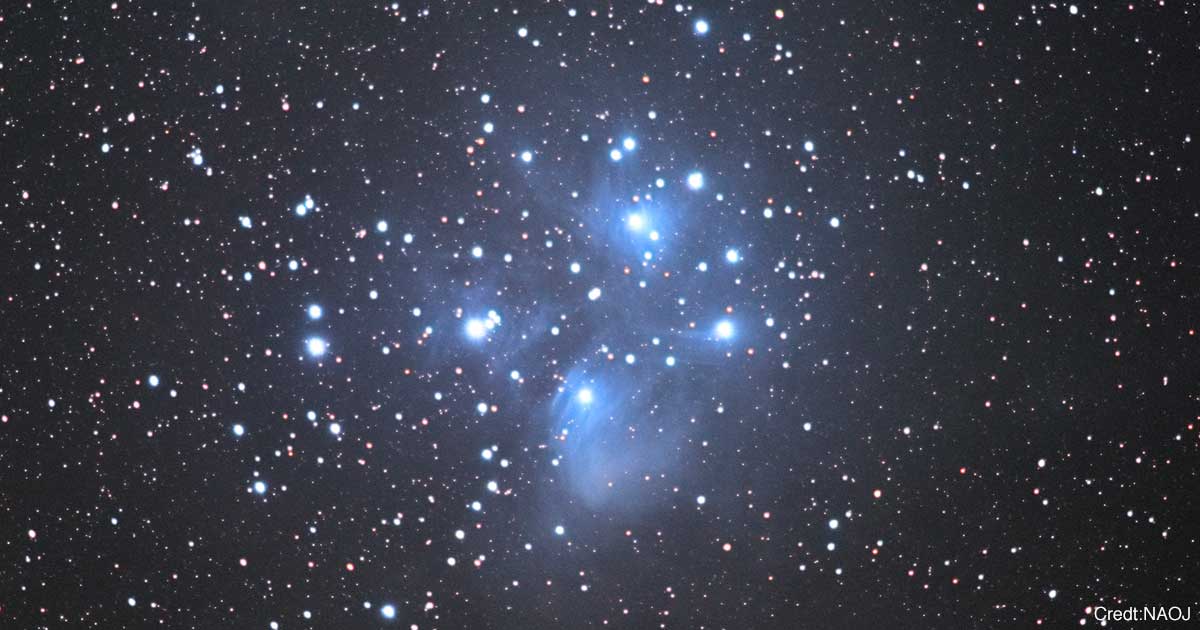
メシエ天体 | 国立天文台(NAOJ)
国立天文台が撮影したメシエ天体の画像を掲載しています。
www.nao.ac.jpThe Orion Nebula
M42 is the single most rewarding nebula target in binoculars. Through a 7x50, the fuzzy patch in Orion's sword opens into a soft luminous cloud, bright at the center and fading into wing-like extensions. The overall silhouette is easy to read, and even a complete beginner will recognize immediately that this is not just another star.
The 10x50 sharpens the contrast between the bright core and the surrounding nebulosity, making it easier to trace the shape. The region around the Trapezium appears more concentrated, and you can follow where the nebula thickens and where it thins. Resolving the individual Trapezium stars cleanly is not realistic at this aperture and magnification, but the core does tighten up noticeably. The 7x50 emphasizes the spread of the wings; the 10x50 emphasizes the form and the bright heart.
The Andromeda Galaxy
M31 is the target most likely to underwhelm if you arrive expecting photographic spiral arms and dust lanes. Through binoculars, however, it becomes a powerful demonstration of sheer scale. The 7x50 shows the nucleus surrounded by an elongated, softly glowing halo that tapers off gradually. Under dark skies the extent of that glow is genuinely impressive, and the 7x50's wide, bright field lets you appreciate it as a single surface.
The 10x50 compresses the nucleus slightly, making the galaxy's position and presence more definitive. This matters most under Light pollution, where the 7x50's rendition can dissolve into the background glow while the 10x50 still grabs the bright core. On the other hand, the broad, gentle sweep of the outer halo is the 7x50's territory. If the goal is detection -- "finding" the galaxy confidently -- the 10x50 has an edge. If the goal is savoring the faint, vast cloud, the 7x50 is the better instrument.
A compact summary of suitability by target type:
| Target type | 7x50 suitability | 10x50 suitability |
|---|---|---|
| Constellation sweeps | Wide coverage makes this effortless | More magnification, but less panoramic reach |
| Open clusters | Layouts visible at a glance | Better star count and sense of concentration |
| Emission/reflection nebulae | Overall extent easy to grasp | Contrast and shape easier to read |
| Galaxies | Faint outer glow visible across a wider area | Nucleus stands out, detection is easier |
Mapped onto real targets this way, the 7x50 emerges as a tool for seeing bright, wide, and relaxed, while the 10x50 is a tool for seeing a step closer and with more presence. Differences that hide behind spec-sheet numbers become concrete when you compare them on the Milky Way, M45, M42, and M31.
Which Is Easier to Use? Hand Shake, Dark Skies, Light Pollution, and Age
Controlling shake and fatigue
When you compare a 7x50 and a 10x50 in the field, the first thing you notice is the magnification gap itself. At 10x every small tremor in your hands is amplified equally, so stars stop being tight points and start to smear or double slightly. On paper "only 3x difference" sounds modest, but in handheld observing that gap is surprisingly large. You might set out to trace the faint outline of a nebula and find that shake has eaten the very detail you were after.
The 7x50, by contrast, keeps the image noticeably calmer. Sweeping a wide area is easy, tracking stars across the field takes little effort, and fatigue builds slowly. The amount of time you can hold the binoculars up and still enjoy a steady view is markedly longer at 7x than at 10x. The 10x50 can feel impressively sharp in a brief glance, but over several minutes the cumulative tension in arms, shoulders, and neck degrades the image.
Fifty-millimeter binoculars are not all lightweights, either. The Nikon WX 7x50 IF weighs 2,420 g (~5.3 lb), which underscores how firmly this class sits in "supported viewing" territory. A heavy 10x50 demands serious attention to how you hold it before optical quality even enters the conversation. A monopod, a tripod, or simply bracing your elbows against something solid all help. Even without dedicated support, leaning against a wall, resting your arms on an armrest, or reclining in a lawn chair can tame the shake considerably.
The reversal between dark skies and light-polluted skies
Exit pupil plays out straightforwardly under dark skies. The 7x50's ~7.1 mm exit pupil rewards full dark adaptation with a bright, spacious view; the Milky Way's tonal range and broad star fields read beautifully. Sweeping the summer Milky Way from a rural site, the 7x50 can produce a sensation of drifting inside the sky itself. Wide open clusters and the broad glow of M31 benefit from this same quality.
Under urban or suburban skies, though, the situation flips. When the sky background is already bright, a large exit pupil feeds that glow into your eye along with the starlight. The 7x50 can make the sky look somewhat washed out, and faint targets sink into the background. Here the 10x50's 5.0 mm exit pupil works in your favor. The background darkens perceptibly, the subjective contrast improves, and targets begin to separate from the glow. The feeling that a 10x50 is "easier to see through" under Light pollution comes not just from magnification but from this exit-pupil effect.
This reversal shows up regularly in practice. Under suburban fringe skies, M45 through a 7x50 looks lovely in overall form but the background is noticeably bright, softening the crispness of individual stars. Switch to the 10x50 and the cluster tightens up, with stars near the center popping more clearly off the field. M42 follows a similar pattern: the 7x50 captures the nebula's spread, but the 10x50 pushes the bright core forward with more authority.
Under genuinely dark rural skies, the 7x50 reasserts itself. M31's glow extends further and more naturally, the Milky Way's gradations flow smoothly, and the overall impression is one of spaciousness. The 10x50 still picks up dark lanes and dense clusters more readily, but for the sheer sense of an open, luminous sky the 7x50 leads. The practical takeaway: dark skies favor the 7x50's large exit pupil; Light pollution favors the 10x50's tighter background.
💡 Tip
If you find yourself thinking "this 50 mm binocular isn't as bright as I expected" from a light-polluted site, the issue is usually not the instrument. The background sky is being brightened along with the stars. The 10x50 can help in that scenario because it changes how the field's background is rendered, even though the light-gathering power is identical.
Age and pupil diameter: a practical consideration
The 7x50's large exit pupil is a genuine strength, but its benefit is bounded by how much light your eye can actually accept. The commonly cited figure of ~7 mm for dark-adapted pupils applies to younger observers under ideal conditions; with age, maximum dilation often falls short of that. When your pupils open to only about 5 mm, the 7x50's extra light cone goes unused, and the effective brightness gap between it and a 10x50 narrows considerably.
This is easy to miss when reading spec sheets. A younger observer using a 7x50 under a dark sky will likely feel the image is noticeably brighter and more comfortable. An older observer with the same instrument may still enjoy the stability and wide field, but the brightness edge shrinks. The 7x50 does not become worse with age; its advantage shifts from raw brightness to ease of viewing and stability.
In practical terms, older observers often rate the 10x50 more favorably than younger ones do. A 5 mm exit pupil matches a wider range of pupil sizes without waste, and the tighter background works well under the suburban skies where many people observe. Meanwhile, the 7x50's strongest case -- maximum brightness, maximum exit pupil -- peaks when a young observer with fully dilated pupils meets a genuinely dark sky. The advantage is real, but it is conditional, not absolute.
Deciding between handheld and tripod use
Hinode's practical guideline -- "6x30 for handheld, 10x50 for tripod" -- holds up well. In astronomical observing, what you can see depends not just on aperture but on the total system performance, including how you hold the instrument. Applying that logic to the 7x50 and 10x50: handheld-first observers lean toward the 7x50; observers who will mount the binoculars lean toward the 10x50.
For handheld use, the 7x50 sits near the practical ceiling of what 50 mm can deliver without support. It is not as effortless as a 6x30 or 8x40, but it preserves the light-gathering advantage of 50 mm while keeping shake well below the 10x threshold. Constellation sweeps, Milky Way runs, and wide open clusters are its natural territory.
When a tripod or monopod enters the picture, the 10x50 becomes far more compelling. Fixing the binoculars eliminates the shake penalty, leaving you with the magnification benefit and the tighter background as pure gains. The bright core of M42, the nucleus of M31, the dense heart of an open cluster -- the 10x50's "one step deeper" capability shows most clearly on a stable mount. If you plan to use 50 mm glass as serious observing equipment, the 10x50 paired with a tripod is a strong combination.
A concise rule of thumb: suburban fringe, handheld: 7x50 or lighter 6x30/8x40. Rural dark site or any site with a monopod/tripod: 10x50 comes into its own. The question is not which is better but under which conditions each one's strengths emerge.
Eyeglass Users, Prism Types, and Structural Differences
What "easy viewing" means for eyeglass wearers
If you observe with glasses on, the first spec to check is not magnification or aperture but eye relief. This is the distance from the Eyepiece at which the full field of view remains visible. Both Nikon and Hinode note that eyeglass users should look for at least 15 mm. When eye relief falls short, the center of the image is fine but the edges clip away, effectively shrinking a wide-field binocular into a narrow one.
For stargazing, this matters more than you might expect. Finding a target is one thing, but genuinely enjoying a sweep of the Milky Way or the full breadth of a large cluster requires the field edge to be visible and clean. Glasses also introduce variables like eyelash clearance and stray light sneaking past the lens rims, both of which erode contrast if the eyecup design is not up to the task. Whether the eyecups fold down neatly and whether the binocular sits steadily against your face are practical details that no spec sheet captures.
Long-eye-relief designs address this head-on. Beyond simply making the view accessible with glasses, they reduce the precision required for eye placement, which is a meaningful advantage when fumbling in the dark. The Nikon WX 7x50 IF, with its 17.7 mm eye relief, is a clear example of this philosophy. The WX is an exceptional and large instrument, but the design principle applies equally to more mainstream models.
One trade-off to keep in mind: achieving both a wide apparent field and long eye relief simultaneously is optically challenging, and budget models often compromise on one or the other. Chasing wide-field specs in a catalog without checking eye relief can lead to disappointment when the outer part of the field disappears behind your glasses.
Porro vs. roof prisms
The visual character and handling of a binocular depend heavily on its prism type: Porro or roof (Dach). Porro prisms produce the familiar offset shape where the eyepieces and objectives are not in line. Roof prisms yield a slimmer, straight-through body. In a shop the roof design often looks sleeker and more modern, but the story is more nuanced for astronomical use.
Porro-prism binoculars inherently lose less light in the prism path and tend to deliver a crisper, more transparent image. The body is bulkier, but at a given price point they frequently outperform roof-prism equivalents on contrast and brightness -- qualities that matter when you are trying to detect a faint nebula. The 50 mm Porro has been a staple of amateur astronomy for decades precisely because the design prioritizes optical throughput over compactness.
Roof-prism binoculars win on portability and compactness. They pack into a bag more easily and serve well as dual-purpose day/night instruments. The catch is that a roof prism demands tighter manufacturing tolerances and phase-correction coatings to match the image quality of a Porro. Inexpensive roof-prism models often fall behind on contrast and sharpness -- a gap that does not show up in the specs. High-end roof-prism binoculars can combine portability with excellent optics, but the price reflects the engineering involved.
As a general guide for beginners: prioritize image quality, choose Porro; prioritize portability, choose roof. A Porro is larger but tends to deliver more optical satisfaction per dollar. A roof is sleek and travel-friendly but demands a higher budget to match the same level of optical performance. For dedicated stargazing, Porro has the edge; for a single instrument that covers daytime hiking and nighttime stargazing, a roof prism makes a strong practical case.
Waterproofing and focus type: practical field details
For nighttime binoculars, waterproofing and fog resistance are nearly as important as optics. Observing often happens on dewy grass, near the coast, or on a cool highland where the temperature differential between the instrument and the air invites condensation. A waterproof, nitrogen-purged body guards against sudden fogging and internal moisture, giving you one less thing to worry about in the dark.
Focus mechanism matters too. Most general-purpose binoculars use a center-focus wheel that adjusts both barrels together -- convenient, quick, and ideal for daytime or mixed use. For stargazing, where you set focus near infinity and rarely change it, individual-focus (IF) barrels have a loyal following. The mechanism tends to be more robust, and once set, the focus point does not drift from an accidental nudge. The "IF" in Nikon WX 7x50 IF stands for individual focus, signaling an instrument designed with sustained astronomical use in mind.
💡 Tip
Center focus offers versatility; individual focus offers rock-solid stability for seated, extended observing. If the binocular will pull double duty between day and night, center focus is the pragmatic choice. If stargazing is the primary purpose, individual focus is worth considering.
In practice, handheld grab-and-go use pairs well with center focus and a waterproof roof or lightweight Porro body, while dedicated astronomical use pairs well with a waterproof Porro or individual-focus instrument on a stable mount. Choosing a binocular by magnification and aperture alone invites surprises from these less glamorous specs; factoring in glasses, carrying style, and whether you observe primarily by day or night tightens the decision considerably.
Which One Should You Pick? A Quick-Reference Table
Condition-based recommendations
This is not about declaring a winner but about matching conditions to the format that fits. The 7x50 leans toward wide, relaxed viewing; the 10x50 leans toward larger image scale and detection. In most cases the deciding factors boil down to how dark your sky is and whether you will observe handheld.
| Condition | 7x50 | 10x50 | Key consideration |
|---|---|---|---|
| Handheld only | Yes | No | Lower magnification keeps the image stable and reduces fatigue over long sessions. |
| Constellation sweeps and wide star fields | Yes | Marginal | Broad coverage makes it easy to follow patterns; wide targets like M45 fit naturally. |
| Dark rural sky | Yes | Yes | 7x50 excels on spacious brightness; 10x50 excels on magnified detection. Choose by intent. |
| Suburban or light-polluted sky | No | Yes | The tighter exit pupil darkens the background, helping targets stand out. |
| Eyeglass use | Yes | Yes | Neither wins on magnification alone. Eye relief of at least 15 mm is the real priority. |
| Tripod or monopod available | Marginal | Yes | Stabilization removes the shake penalty, letting magnification pay off fully. |
| Want clusters and nebulae a bit larger | No | Yes | M42's presence, M31's nucleus, and open-cluster grain all benefit from 10x. |
As a supplementary option, 6x30 and 8x40 models are strong contenders when pure handheld comfort is the top priority. They collect less light than a 50 mm, but for casual constellation-hopping their lightness translates directly into satisfaction -- especially for sessions involving frequent raising and lowering, or for observers who carry the binoculars on a neck strap while walking.
When you cannot decide, prioritize in this order
Rather than weighing every preference at once, stepping through four questions in sequence usually settles the matter.
- How dark is your observing site?
- Handheld or tripod?
- Do you prefer wide-field sweeping or individual-target study?
- Do you wear glasses?
Sky darkness comes first. If you have access to a dark site and want to drift through the Milky Way and broad star fields, the 7x50 is the natural direction. If you observe mostly from a suburban location and want to pull out M42 or M31 as clearly as possible, the 10x50's logic is stronger. Under a bright sky, the 7x50's large exit pupil is harder to convert into a clear advantage.
Next is how you plan to hold the instrument. For handheld use, the 7x50's stability counts. At 10x the shake is disproportionate to the "only 3x more" on paper, and over an extended session fatigue compounds it. With a tripod or monopod in the mix, the 10x50's weakness vanishes and its strengths come forward.
Third, consider what you want to look at. If the goal is tracing constellation lines, riding the Milky Way's tonal shifts, or framing M45 at a comfortable scale, the 7x50 fits. If you want open clusters with more resolved grain, M42 with a more assertive core, or M31's nucleus punching through confidently, the 10x50 is the match. The split is essentially "savor the whole sky" versus "dig into individual targets."
Eyeglasses come fourth, but they are not negligible. With glasses on, comfort depends less on magnification and more on whether you can see the full field from a comfortable distance. The practical threshold is roughly 15 mm of eye relief. Even if you have settled on a 7x50 or 10x50, a candidate with short eye relief will undermine the experience.
💡 Tip
The short version: dark sky, handheld, wide sweeps -- 7x50. Brighter sky or tripod-supported, individual targets a bit larger -- 10x50. Layer on long eye relief if you wear glasses, and the path forward becomes clear.
Representative specs
The Nikon WX 7x50 IF and WX 10x50 IF illustrate how two high-end instruments divide their design priorities between the two formats. The figures below are specific to the WX series; mainstream 7x50 and 10x50 models will have different true-field and eye-relief values. This comparison shows where a flagship design places its emphasis.
| Spec | Nikon WX 7x50 IF | Nikon WX 10x50 IF |
|---|---|---|
| True field of view | 10.7 degrees | -- |
| Apparent field of view | 66.6 degrees | 76.4 degrees (cited in some sources; not confirmed in all official documentation) |
| Eye relief | 17.7 mm | -- |
The pattern is clear: the 7x50 invests in wide true field for spatial coverage, while the 10x50 pushes high apparent field for immersion and image scale. The WX 7x50 IF also weighs 2,420 g (~5.3 lb), placing it firmly in "mount it and settle in" territory rather than casual handheld use. At the flagship level, the binocular's physical profile becomes part of the observing-style decision, not just an afterthought.
For eyeglass wearers, the WX 7x50 IF's 17.7 mm eye relief is a reassuring benchmark. Real-world comfort also depends on eyecup shape and facial fit, but the number itself provides a solid starting point. A 10x50 with equally generous eye relief will work just as well; the key is to check that spec before magnification when reading a product page.
Adding the 6x30 and 8x40 to the picture sharpens the lineup: 6x30 maximizes handheld convenience; 8x40 balances stability with moderate magnification; 7x50 owns wide-field dark-sky viewing; 10x50 goes one step deeper into 50 mm territory. On paper the numbers sit close together, but in practice the use cases sort themselves out clearly.
Preparing for an Observing Session
Dark adaptation and managing Light pollution
Session quality depends as much on preparing your eyes as it does on the binoculars themselves. For faint targets, you get far more out of the view by letting your eyes adjust to the dark before you start than by diving straight in. Allow at least 15 to 30 minutes for dark adaptation; skimping on this makes diffuse objects like M31 or subtle Milky Way structure noticeably harder to detect.
The biggest threat to dark adaptation is white light. A phone screen, even briefly, can set you back several minutes. Dim the display aggressively and switch to a red-light mode. If you need a star chart or mapping app, keep the interaction short. I have found that checking my phone repeatedly right after setting up gear leaves a window of several minutes where the faintest parts of the sky are visibly harder to pick up.
Positioning yourself thoughtfully helps too. Even at a site with nearby streetlights, moving a few paces so that no light source falls directly in your line of sight can transform the view. The shadow of a building, a parked car, or a line of trees can serve as a shield. You cannot change the sky's overall brightness, but removing point sources of glare from your field of vision raises contrast immediately.
Moonlight is another factor that is easy to overlook. For nebulae and galaxies, the best results come around the new moon. Even a quarter moon riding high washes out the sky enough to hamper faint-object detection. Beyond the moon's phase, paying attention to moonrise and moonset times gives you practical scheduling leverage -- targeting the hour or two after the moon drops below the horizon, for example.
For choosing a site, a Light pollution map beats guesswork. Tools like Light Pollution Map display Bortle-scale ratings and sky-brightness indicators, making it straightforward to compare candidate locations and pick the darkest option within a reasonable drive. On nights when you want to get the most from a 7x50's wide, bright field, this kind of homework translates directly into a better experience.
Safety, warmth, and etiquette
After dark, personal safety comes before equipment. Uneven ground, drainage ditches, mud, and icy patches are hard to spot when your attention is aimed skyward. Before you start observing, survey the ground where you will stand, confirm there is nothing hazardous behind you if you step back, and note any vehicle traffic patterns if you are near a road or parking area.
Winter observing is physically draining in ways that catch people off guard. Standing still and looking up for extended periods chills you faster than walking would, even at moderate temperatures. In cold climates, plan for conditions around -10 degrees C (14 degrees F) with a three-layer system: a moisture-wicking base layer, an insulating mid layer, and a windproof shell. Seal the gaps at your neck, wrists, and ankles where cold air creeps in. Gloves need to be thin enough to operate a focus wheel and a phone -- keeping a pair of thin liner gloves underneath heavier mittens works well. Cold feet destroy concentration faster than almost anything else, so insulated footwear with a solid sole barrier against the frozen ground is essential.
Planning your departure is part of the session. Late at night, traffic thins but so do open rest stops and services. If you are heading into a mountain area or a rural site, lock in your return route and timing before you leave. After a long observing run your alertness drops; rushing to pack up only makes that worse. Take a few minutes to warm up before driving.
Consideration for others rounds out a good session. Avoid firing a white flashlight in a group setting, stay off private land and farm tracks unless you have permission, and keep car doors and conversation volume low. In quiet locations sound and light carry far, and minimizing both is the simplest form of courtesy.
ℹ️ Note
Never point binoculars or a telescope at the Sun. The only exception is when a dedicated solar filter is correctly and securely mounted over the objective end, following established procedure. Even when sunlight seems manageable to the naked eye, optical instruments concentrate it enough to cause serious and permanent eye damage.
Tonight's checklist
Running through a short list before you head out catches the things that are easy to forget.
- Begin dark adaptation 15 to 30 minutes before you plan to start observing
- Set your phone to red-light mode and reduce brightness
- Choose a standing position where no streetlight enters your direct line of sight
- Check the moon phase and moonrise/moonset times
- Review your site's sky darkness on a Light pollution map
- Gather binoculars, tripod or monopod if needed, and a lens cloth
- Carry a light for your feet and check the walking surface in advance
- In winter, dress for around -10 degrees C (14 degrees F) with layers, gloves, a hat, and insulated boots
- Plan your return route and factor in a drink or rest break
- Never observe the Sun through binoculars or a telescope without proper solar filtration
The point of preparation is twofold: drawing the best performance from your equipment, and making sure you get home comfortably and safely. When both are handled, the 7x50's gift for wide, relaxed sweeping and the 10x50's gift for pulling targets one step closer both show through clearly.
Frequently Asked Questions
Does the brightness advantage of 7x50 hold up in urban skies?
Not necessarily. The 7x50 is at its best under genuinely dark skies where your eyes are fully dark-adapted, producing a relaxed, luminous image. Under urban or bright suburban skies, however, the background glow itself becomes prominent. Because the 7x50's generous exit pupil delivers that background light just as efficiently as it delivers starlight, overall contrast can suffer.
From my own observing, light-polluted sites sometimes make the 7x50 feel less like "bright and easy" and more like "everything is bright, sky included." The 10x50 tightens the image slightly, giving star clusters and nebulae a better chance of registering against the field. Assuming the 7x50 always has the upper hand in the city is a common misstep; factoring in how dark the sky actually is leads to a more practical choice.
I wear glasses. Which is better, 7x50 or 10x50?
The magnification matters less than whether the eye relief is at least 15 mm. Observing with glasses on requires enough clearance between the Eyepiece and your eye to see the entire field of view. That clearance is eye relief. If it falls short, the edges clip away and even a wide-field instrument feels cramped.
Both 7x50 and 10x50 models come in eyeglass-friendly designs, and both formats include models that are poor matches for glasses. The Nikon WX 7x50 IF, for instance, offers 17.7 mm of eye relief -- a comfortable margin. When a manufacturer publishes that number clearly, it simplifies the decision. For eyeglass wearers, the spec sheet is more decisive than the format label.
Can I use 10x50 binoculars handheld?
Yes, though shake is noticeably worse than with a 7x instrument. At 10x every small hand movement is amplified along with the image, so while a quick look works fine, sustained viewing over several minutes becomes challenging. The effect is most pronounced on faint, extended targets like M42 or M31, where shake directly undermines the view.
Remedies are simple. Press your elbows lightly against your torso, lean on a wall or vehicle, or sit and brace on your knees. A monopod or tripod raises the experience substantially, letting the 10x50's magnification advantage come through without interference. Handheld use is entirely workable, but the moment you add stabilization the 10x50 jumps up a level.
Which binoculars work best for sharing with kids and family?
When the binoculars will be passed around, a 7x50 is a forgiving starting point. Its large exit pupil means the image stays visible even when someone's eye is slightly misaligned, cutting down on the frustrating "I can't see anything" moments that discourage beginners. For tracing constellations or sweeping the Milky Way, that tolerance makes a real difference.
On the other hand, 50 mm binoculars are inherently on the heavy side, and smaller or younger users will feel it. Lighter options like a 6x30 or 8x40 are very practical for that reason. Personally, I would set a 7x50 on a support and invite people to look, but hand a 6x30 or 8x40 to anyone who wants to roam freely. In a shared setting, "can they hold it comfortably" and "can they find the view quickly" drive satisfaction more than optical performance.
Should I worry more about weight than about price?
Weight deserves real attention. Well-built 50 mm binoculars tend to be heavy, and no matter how appealing the specs look, holding the instrument skyward for an extended period accumulates physical strain. The Nikon WX 7x50 IF weighs 2,420 g (~5.3 lb / roughly 85 oz) -- optically outstanding, but not something you pick up on a whim.
Binoculars only deliver their potential if you actually take them outside and use them. Whether you observe from a balcony for a short session, walk a distance from the car, or sit in a reclining chair changes how much weight you can comfortably tolerate. Price is straightforward to compare, but in terms of everyday satisfaction weight tends to be the stronger predictor. The longer your sessions run, the harder this factor is to dismiss.
Summary and Next Steps
The two axes that matter most are where you observe and how you support the binoculars. The 7x50 sweeps wide and bright, thriving under dark skies. The 10x50 sharpens detection and detail, tightening the background under Light pollution. At 10x, though, hand shake takes a bigger toll, so real-world performance depends as much on technique as on the glass itself.
Three steps are enough to move forward.
- Settle on your typical observing site's darkness level, and decide whether you will observe handheld or with a tripod
- If you wear glasses, confirm the eye relief is at least 15 mm
- Pick your first target from M45, M42, M31, or the Milky Way
If you want to firm up the comparison from here, existing observation guides are a natural next step. Reading an Orion Nebula (M42) observing guide or a Pleiades (M45) deep-dive first will connect the equipment choice directly to your first night out.
Related Articles
How to Start Stargazing: 5 Steps You Can Do Tonight
How to Start Stargazing: 5 Steps You Can Do Tonight
You don't need a telescope to start stargazing. Begin with bright, easy targets like the Moon and Venus, then gradually add binoculars and — if you want — a telescope. Starting with naked-eye objects and building from there is the approach least likely to leave you discouraged.
Top 20 Stargazing Spots in Japan: A Beginner's Comparison Guide
Top 20 Stargazing Spots in Japan: A Beginner's Comparison Guide
Picking a stargazing spot by reputation alone can lead to disappointment. This guide compares 20 stargazing locations across Japan by sky darkness, accessibility, observation style, and beginner-friendliness — so you can find the one that actually fits your trip.
How to Find Constellations: The Fastest Route Through All Four Seasons
How to Find Constellations: The Fastest Route Through All Four Seasons
The fastest way to learn the night sky isn't memorizing all 88 constellations at once — it's finding one obvious seasonal landmark and working outward from there. Step outside around 9 PM, face south, and start with the Big Dipper in spring, the Summer Triangle in summer, the Great Square in autumn, and Orion in winter.
How to Find and Observe the Andromeda Galaxy M31 with Binoculars
How to Find and Observe the Andromeda Galaxy M31 with Binoculars
The Andromeda Galaxy M31 is a signature autumn target that beginners can realistically spot with binoculars under the right conditions. It is not an impossibly difficult object, but you will not see the swirling arms and vivid colors of photographs -- in practice, the challenge is picking out a faint, elongated glow. Based on my own experience, I rate it around intermediate difficulty (roughly Level 3).